

Cart
0
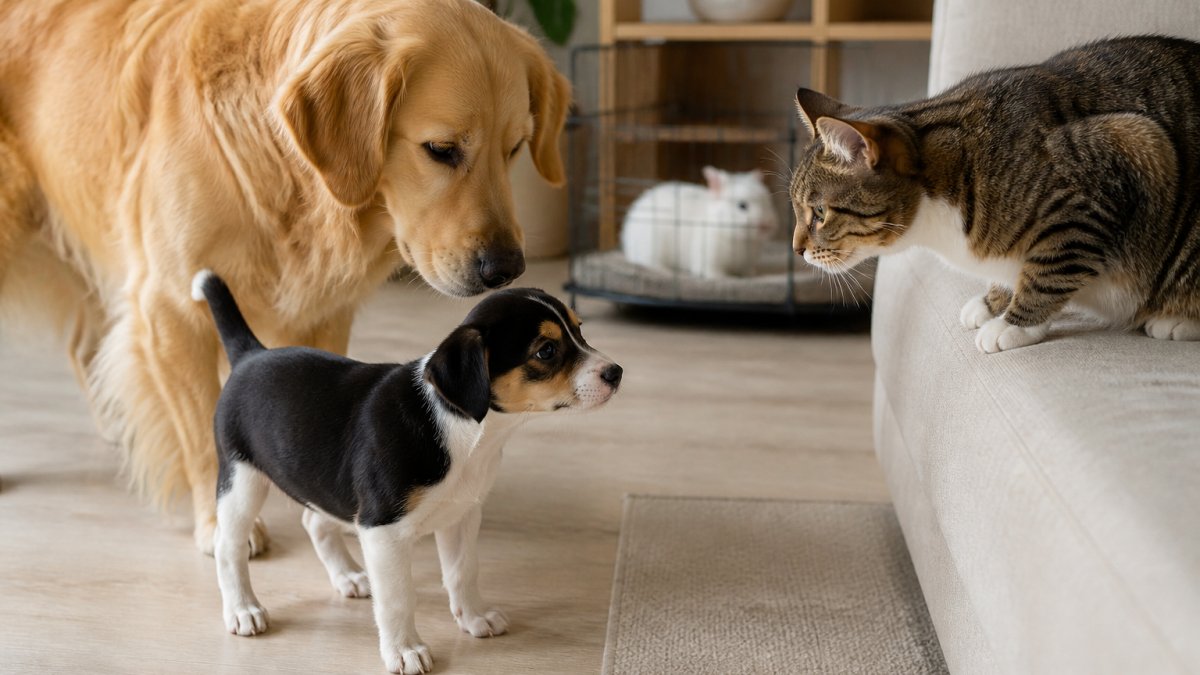
Last Updated: October 24, 2026
Quick Summary
To introduce a puppy to other pets, start with scent swapping and full separation for the first three days, then move to barrier meetings through a baby gate or playpen with the puppy leashed. Advance only when readiness checks are met, keeping early sessions to two to five minutes, and always give resident pets escape routes and separate feeding stations.
- Start both dogs on leash 15 to 20 feet apart on neutral ground, adding distance if either stiffens.
- Keep first sniff greetings to three seconds, then move on and repeat over several sessions.
- Move small-pet enclosures to sturdy surfaces at least waist-high or into a room the puppy cannot access.
- Keep leashed visual meetings with small pets at least six feet back and under five minutes.
- Wait for two full weeks of incident-free supervised sessions before leaving pets alone together.
Table of Contents
- Before the First Meeting: Set Up Your Home and Pets
- Introducing a Puppy to a Resident Dog
- How to Introduce a Puppy to a Cat
- Introducing a Puppy to Small Pets Safely
- How Long to Keep a New Puppy Separated from Other Pets
- Reading Body Language: Warning Signs to Watch For
- Troubleshooting Introductions That Are Not Progressing
- Stock Your Puppy Introduction Kit at Pawsibly Everything
- Frequently Asked Questions
Before the First Meeting: Set Up Your Home and Pets
A successful introduction starts days before the puppy walks through your door. New pet parents often ask: how to introduce a puppy to other pets is about preparation, not luck.
Give every animal its own space, routine, and reason to feel safe.
Create a Safe Space for the Puppy
Set up a quiet room or pen before arrival day with a bed, water, and chew toys. It becomes the puppy's retreat and keeps resident pets from feeling ambushed.
- Choose a low-traffic room away from resident pets
- Add a crate or playpen with soft bedding
- Keep food and water bowls separate from other pets
If you live in an apartment, our guide on how to puppy proof an apartment safely covers the details that matter most.
Prep Your Resident Pets
Resident dogs and cats pick up on change fast, so never spring the new puppy on them without warning. Start with scent: bring home a blanket that smells like the puppy and let your resident pet sniff it at their own pace.
Then check the basics:
- Update vaccinations and vet visits
- Trim nails and brush coats
- Set up a separate feeding station
A tired, well-exercised resident dog handles change better than a bored one. A long walk before the first meeting helps more than most people expect.
Introducing a Puppy to a Resident Dog
Introducing a puppy to a resident dog works best on neutral ground, on leash, and at a distance. Rushing this step is the number one reason introductions go sideways.
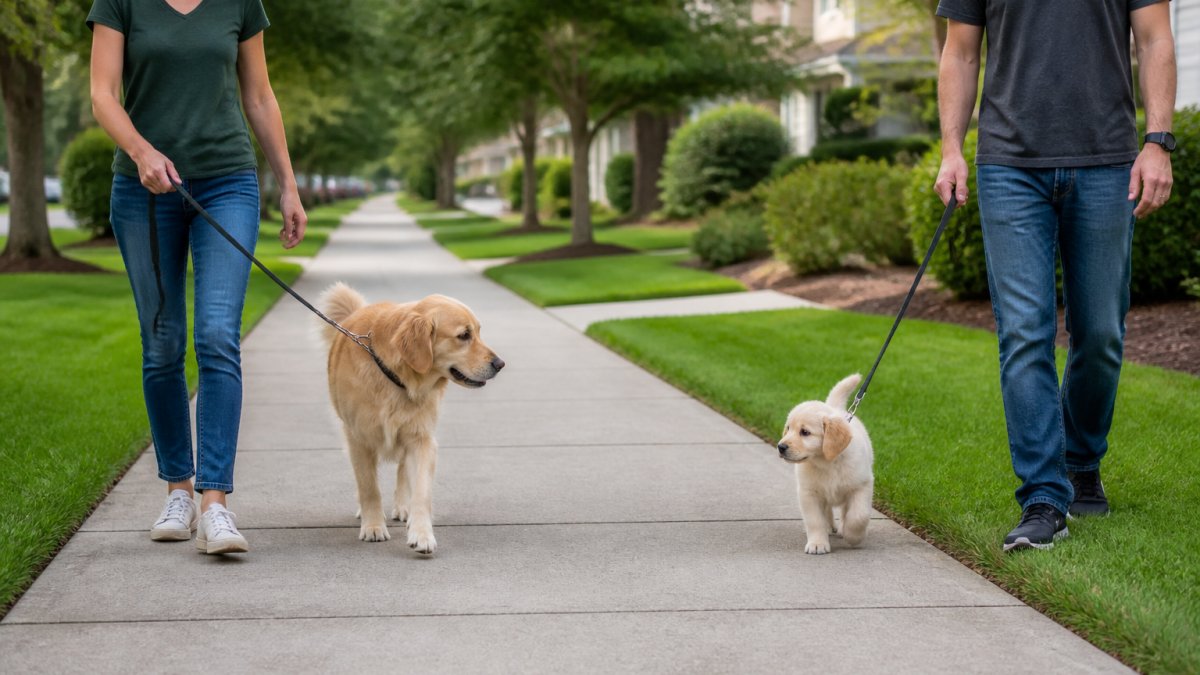
Choosing Neutral Territory and Starting at a Distance
Pick a spot neither dog considers home, a quiet park, a friend's yard, or a calm street corner.
The puppy needs age-appropriate protection here. Until vaccinations are complete, ask your vet which locations are safe. The American Veterinary Medical Association guidance on puppy socialization covers how to balance safety with early exposure.
Parallel Walks and Supervised Greetings
Parallel walking is the workhorse of dog introductions: two handlers, two leashes, one direction, plenty of distance. Walk five to ten minutes side by side but not touching, then close the gap slightly on the next pass.
A long leash gives you room to manage distance without crowding either dog.
When both dogs look relaxed, allow a brief sniff. Keep it to three seconds, then move on. Repeat over several sessions.
Watch out: letting dogs greet face-to-face on tight leashes creates tension. Tight leashes pull dogs toward each other and turn a friendly sniff into a tense standoff.
How to Introduce a Puppy to a Cat
Cats need a slower runway than dogs. How to introduce a puppy to a cat comes down to barriers, escape routes, and scent before sight.
Start with closed-door scent swapping. Rub a cloth on the puppy and place it near the cat's bed. Swap it after a day.
Barriers, Escape Routes, and Scent Swapping
A baby gate lets the cat see and smell the puppy without contact. The cat must always have a clear path to jump up and away.
- Keep the puppy leashed during first visual meetings
- Give the cat high perches and hiding spots
- Feed the cat in a separate room
A tunnel toy gives your cat a fun escape route and something to do while the puppy settles in. Our cat tunnel and play tube works well for this.
Cats show stress through hiding, flattened ears, and a swishing tail. Back off when you see those signs.
Introducing a Puppy to Small Pets Safely
Small pets carry real risk: rabbits, guinea pigs, hamsters, birds, and reptiles are prey animals, and even a playful puppy can injure them with one paw swipe or pounce. Manage the enclosure, manage the puppy's prey drive, and accept that coexistence, not friendship, is the realistic goal.
Why Small Pets Need a Different Protocol Than Cats
A cat can jump to a counter or swat a puppy's nose; a guinea pig cannot. That asymmetry is why small-pet introductions should never include free-contact greetings. The puppy does not need to "meet" the rabbit, it needs to learn the enclosure is a no-go zone. You are teaching a boundary, not socializing the two animals.
Set Up the Enclosure as a Fortress
Before the puppy comes home, audit every small-pet enclosure against a determined puppy:
- Height and stability. A cage on a low stand is an invitation. Move enclosures to sturdy surfaces at least waist-high, or into a room the puppy cannot access without you.
- Bar spacing. A puppy's nose and paws fit through wider bars than you expect. Check that the puppy cannot reach through to nip or paw at the animal inside.
- Lid security. Hamsters and birds are escape artists, and a puppy bumping a cage can pop a loose lid. Use locking clips on every opening.
If the enclosure cannot be made puppy-proof, the small pet needs a dedicated room with a closed door, not a hallway with a baby gate the puppy can jump.
Train the Puppy Before Any Visual Introduction
Start with the puppy on a leash at the far end of the room, well outside the small pet's flight zone. Reward it for looking at the enclosure and then back at you, the same "look at that" pattern trainers use for reactive dogs.
Progress only when the puppy can do all three:
- Notice the enclosure without lunging or whining.
- Respond to a sit or name cue while the small pet is visible.
- Settle on a mat at a distance for 30 seconds.
If the puppy cannot pass all three, you are not ready for a closer pass. Add distance and shorten sessions to two or three minutes.
Supervised Visual Meetings, Never Contact
Once the puppy passes the readiness checks, allow brief leashed visual meetings with the small pet secure in its enclosure, keeping the puppy at least six feet back with the leash short enough that a lunge cannot reach the cage.
- Keep sessions under five minutes and end on a calm note.
- Watch the small pet, not just the puppy. Knowing the signs of stress in small pets due to cage size helps you tell when an introduction is too much. A rabbit that freezes, thumps, or presses into a corner is stressed even if the puppy looks relaxed.
- Never open the enclosure during a meeting. Not to pet the rabbit, not to refill water, not for any reason.
Watch Out
A wagging tail is not a safe signal around small pets. A puppy in full prey-drive play bow can flip to a pounce in under a second. Treat every small-pet interaction as a management exercise, not a socialization exercise.
Read Stress in the Small Pet
Small animals hide stress well. Watch for:
- Rabbits: freezing, thumping, flattened ears, pressing into a corner, refusing food.
- Guinea pigs: huddling in a hide, teeth chattering, reduced eating, high-pitched distress whistles.
- Hamsters and gerbils: staying burrowed for longer than usual, bar-biting, pacing, over-grooming.
If you see any of these, back the puppy up to the previous step and give the small pet several days of quiet.
Rotate Free Time So Nobody Lives in a Cage
Separation is not a life sentence. Rotate who is loose in the shared space:
- Puppy in the playpen while the small pet gets floor time in a secure exercise pen.
- Small pet in its enclosure while the puppy gets supervised living-room time.
- Never both loose in the same room at the same time, not even for a minute.
A wire playpen makes this rotation easy without shutting the puppy in a bedroom alone.
Accept the Realistic Outcome
Some puppies grow into calm adults that ignore the rabbit; others never lose the interest, which is a management problem, not a training failure. Safe, stress-free coexistence, with permanent barriers and supervised rotation, is a successful outcome, and the one most multi-pet households with small animals actually live with.
How Long to Keep a New Puppy Separated from Other Pets
The calendar matters less than the readiness checks. A confident resident dog may be ready for supervised time in five days; a fearful cat may need six weeks. Use the timeline below as a default, but advance only when the readiness criteria are met.
The Default Timeline
- Days 1-3: Full separation. No visual contact. Scent swapping only. Each pet keeps its own room or zone, and you rotate attention so nobody feels displaced.
- Days 4-7: Barrier meetings. Visual contact through a baby gate or playpen, puppy leashed, sessions of two to five minutes, two or three times a day.
- Week 2: Brief leashed greetings. Short, supervised, same-room time with the puppy on leash and the resident pet free to leave. End every session while both animals are still calm.
Readiness Checks Before You Advance
Do not move to the next stage until the current one passes. These are the gates:
Before barrier meetings:
- The puppy can settle in its pen for 10 minutes while the resident pet is in the same room.
- The resident pet approaches the barrier voluntarily rather than hiding.
Before leashed greetings:
- Both animals can be in the same room at a distance without stiffening, staring, or vocalizing.
- The resident pet can walk away from the barrier without the puppy lunging or whining.
Before longer supervised time:
- A three-second sniff ends with both animals disengaging on their own.
- The puppy responds to its name and a sit cue while the resident pet is visible.
- The resident pet returns to normal behavior, eating, sleeping, playing, after sessions.
Before unsupervised time:
- Two full weeks of supervised sessions with zero growls, snaps, hard stares, or resource guarding.
- Both animals choose to rest near each other rather than avoiding the shared space.
If any gate fails, drop back one stage for three to five days and retry. Stalling is normal. Pushing through a failed gate is how introductions turn into incidents.
What "Separation" Actually Means
Separation is not isolation. A puppy locked in a bedroom for two weeks comes out over-aroused and harder to introduce. Rotate free time so each pet gets attention:
- Puppy in the playpen while the resident dog gets one-on-one time.
- Resident cat loose in the living room while the puppy naps in its crate.
- Meals always in separate rooms, at the same time, so feeding becomes a shared routine rather than a contested one.
A wire playpen makes this rotation easy without shutting the puppy in a room alone.
When the Timeline Stalls
Some households sit at the barrier stage for a month. That is information, not failure. The most common causes:
- Puppy too aroused at every meeting. Add a 20-minute walk or sniff session before each introduction, and cut sessions to two minutes.
- Resident pet hides or avoids. Stop barrier meetings for a week and go back to scent swapping. Let the resident pet set the pace.
- Resource guarding appears. Feed in separate rooms, pick up all shared toys before meetings, and remove high-value chews from the shared space entirely.
Key Takeaway
The calendar is a guide, not a deadline. Advance on readiness, not on the date. A slow introduction that takes six weeks is cheaper, in stress, in vet bills, and in risk, than a fast one that produces a bite.
Use this default timeline as a guide, but advance only when the readiness checks are met.
| Stage | What happens | Duration or frequency |
|---|---|---|
| Days 1-3 | Full separation, scent swapping only, no visual contact | Each pet keeps own room or zone |
| Days 4-7 | Barrier meetings through baby gate or playpen, puppy leashed | Two to five minutes, two or three times a day |
| Week 2 | Brief leashed greetings, resident pet free to leave | Short supervised sessions |
| Weeks 3-4 | Longer supervised time, puppy leashed or on drag-line | Ten to fifteen minutes |
| Week 5 and beyond | Unsupervised time only after repeated calm sessions | At least two weeks incident-free supervised first |
Reading Body Language: Warning Signs to Watch For
Calm behavior looks loose and wiggly; tension looks stiff and still. Learn the difference before the first meeting, it keeps everyone safe.
Relaxed signals:
- Loose, wiggly body
- Play bow
- Soft eyes and relaxed mouth
Warning signs:
- Stiff body or frozen posture
- Raised hackles
- Lip licking, yawning, or whale eye
If you see warning signs, add distance and end the session. Never scold a growl. A growl is information, and punishing it removes the warning without removing the fear.
Troubleshooting Introductions That Are Not Progressing
Some introductions stall. That is normal. The most common fix is more distance and shorter sessions, ten good minutes beat an hour of stress.
- Puppy too excited? Add exercise before meetings and keep sessions under five minutes
- Resident dog avoids the puppy? Let the dog choose when to approach
- Cat hides constantly? Slow down and go back to scent swapping
Positive reinforcement does the heavy lifting. Treats and praise for calm behavior teach faster than corrections.
Stock Your Puppy Introduction Kit at Pawsibly Everything
A calm introduction needs the right gear. We stock supplies for dogs, cats, birds, fish, and small pets, so one order covers the whole household.
Here is what we suggest keeping on hand:
- Comfortable beds for every pet, including our ice velvet and plush options
- Durable chew toys for the puppy
Our store is designed for multi-pet homes, offering supplies chosen for comfort and well-being.
Frequently Asked Questions
How do you introduce a puppy to a dog you already have?
Start on neutral ground, such as a quiet sidewalk or a friend's yard, with both dogs on leashes. Keep them at a distance where neither is pulling or staring, then walk them in parallel before allowing a brief sniff. Keep the first meeting under five minutes and end on a calm note. Repeat short sessions over several days, rewarding relaxed behavior with treats and praise, before moving to longer, supervised time together at home.
How long should you keep a new puppy separated from other pets?
Plan on roughly one to two weeks of separation, longer if your vet advises it for vaccination or health reasons. During this time, use barriers, crates, and separate feeding areas so pets can smell and hear each other without direct contact. Short, supervised introductions can begin once your puppy is settling in and your resident pets show calm interest. Always confirm the timeline with your veterinarian, especially in multi-pet homes.
What are signs that a pet introduction is going badly?
Watch for stiff posture, hard staring, tucked tails, flattened ears, growling, lip licking, yawning, or a cat that hides and stops eating. These stress signals mean you should increase distance and end the session. If you see snapping, lunging, or a pet guarding food or toys, separate them immediately and consult a certified trainer or behaviorist before trying again. Never push through tension, because repeated scary meetings make future introductions harder.
How do you stop a puppy from chasing a cat?
Manage the environment first: keep the cat's escape routes open, use baby gates, and reward the puppy for looking at the cat and then turning back to you. Practice short training sessions with high-value treats and a solid 'leave it' cue. Keep greetings brief and always supervised. If chasing continues, increase distance and consult a trainer who uses positive reinforcement, since punishment tends to increase fear and tension between pets.
Bringing a new puppy home is exciting, and a little nerve-wracking when you already have pets. The right gear makes the slow, careful introduction far easier to manage. Get started with Pawsibly Everything and give every pet in your home a calm, comfortable start together.


