

Cart
0
Table of Contents
- What Is an Orthopedic Dog Bed and Why It Matters
- Signs Your Dog Needs an Orthopedic Bed
- Memory Foam vs. Egg Crate Dog Beds: Which Is Right for Your Dog
- How to Measure a Dog for a Bed and Choose the Right Size
- Key Features to Look for in an Orthopedic Dog Bed
- Durability, Washability, and Long-Term Value
- Making Your Final Selection
Last Updated: August 17, 2026
What Is an Orthopedic Dog Bed and Why It Matters
An orthopedic dog bed is a specially designed sleeping surface engineered to provide enhanced support and comfort for dogs, particularly those experiencing joint issues, arthritis, or mobility challenges. Unlike standard dog beds, orthopedic options feature high-density memory foam or specialized supportive materials that distribute your dog's weight evenly and reduce pressure on sensitive joints. Since dogs spend 12 to 14 hours sleeping daily, bed quality is a genuine health investment rather than a luxury purchase.
At Pawsibly Everything, we understand that choosing the right orthopedic dog bed requires more than picking the thickest cushion available. The best choice depends on your dog's specific needs, size, sleeping position, and any existing health conditions.
Pro Tip
The most common mistake pet owners make is assuming all memory foam beds are created equal. Foam density and construction quality vary dramatically. A cheap memory foam bed may compress within months, losing its supportive properties entirely. Higher-density foam maintains its structure and support for years.
Signs Your Dog Needs an Orthopedic Bed
Your dog may benefit from an orthopedic bed if you notice difficulty rising from a resting position, visible stiffness when standing after sleep, or reluctance to jump on furniture. Senior dogs, particularly those over seven years old, frequently develop arthritis or hip dysplasia that makes a standard bed uncomfortable.
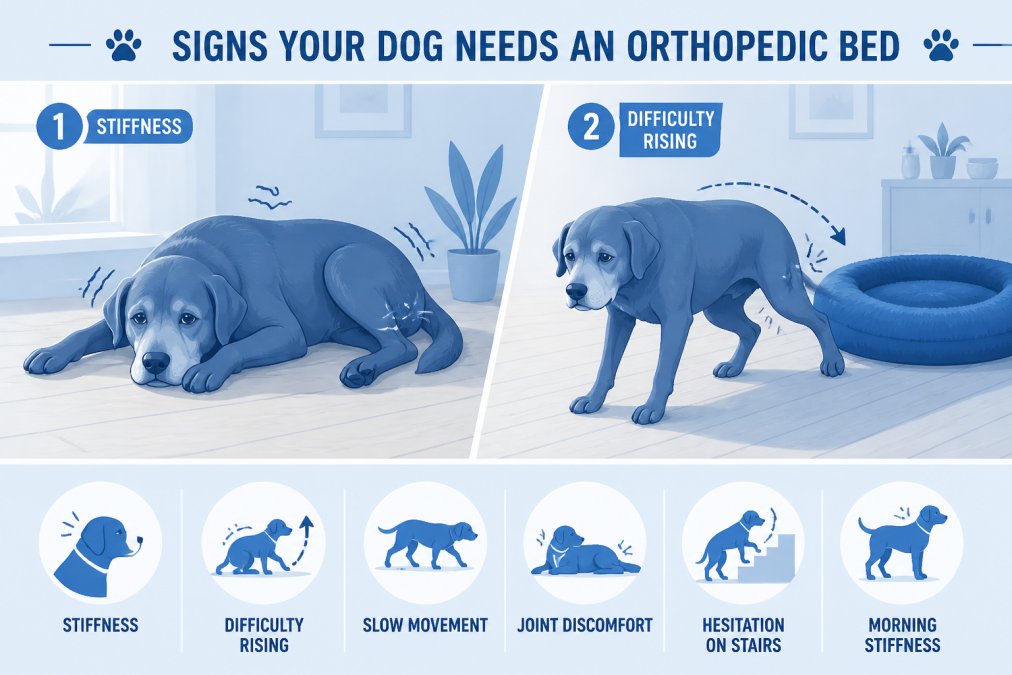
Dogs recovering from surgery or orthopedic procedures absolutely need proper support during healing. Certain breeds prone to joint issues, large breeds like German Shepherds, Golden Retrievers, and Labrador Retrievers, as well as Dachshunds with their long spines, benefit tremendously from orthopedic support even when young.
Watch for behavioral changes too. A dog that suddenly seems reluctant to settle down, constantly shifts positions, or appears uncomfortable may be signaling joint pain. Some dogs will limp slightly after rest but improve once they've moved around. Overweight dogs experience additional joint stress and benefit significantly from orthopedic beds, making supportive foam essential rather than optional.
Watch Out
Ignoring signs of joint discomfort won't make them disappear; they typically worsen over time. Dogs that don't receive proper support often develop compensatory movement patterns, putting stress on other joints. Early intervention with a proper bed can slow progression and improve mobility.
Memory Foam vs. Egg Crate Dog Beds: Which Is Right for Your Dog
Memory foam and egg crate designs represent two fundamentally different approaches to orthopedic support.
High-density memory foam contours to your dog's body shape, distributing weight evenly across the entire surface. This design excels at pressure relief, particularly for dogs with arthritis or post-surgical needs. Memory foam beds maintain consistent support throughout their lifespan when constructed with quality materials and respond to body heat, becoming slightly softer as your dog settles in.
Egg crate foam, also called convoluted foam, features a waffle-like top surface that increases air circulation. Egg crate beds tend to be lighter, more affordable, and easier to clean than memory foam options. The increased airflow helps with temperature regulation, particularly valuable for dogs that sleep hot.
Memory foam provides superior support for dogs with significant joint issues because it maintains firmness under pressure while still conforming to body contours. Egg crate foam offers moderate support and works well for dogs with mild discomfort or those who primarily need comfort rather than therapeutic support.
Consider your dog's sleeping style. Dogs that like to nest and burrow often prefer the enclosed feeling of memory foam. Dogs that stretch out flat may appreciate the lighter feel of egg crate construction. Senior dogs with arthritis typically benefit more from memory foam's consistent support.
Key Takeaway
Memory foam is the superior choice for dogs with diagnosed joint conditions, post-surgical recovery, or significant arthritis. Egg crate foam works well for healthy dogs seeking comfort or those with mild stiffness. The difference becomes apparent within weeks as dogs on proper support show improved mobility and reduced stiffness.
How to Measure a Dog for a Bed and Choose the Right Size
Selecting the correct size is crucial because an undersized bed forces your dog into a cramped position, defeating the purpose of orthopedic support.
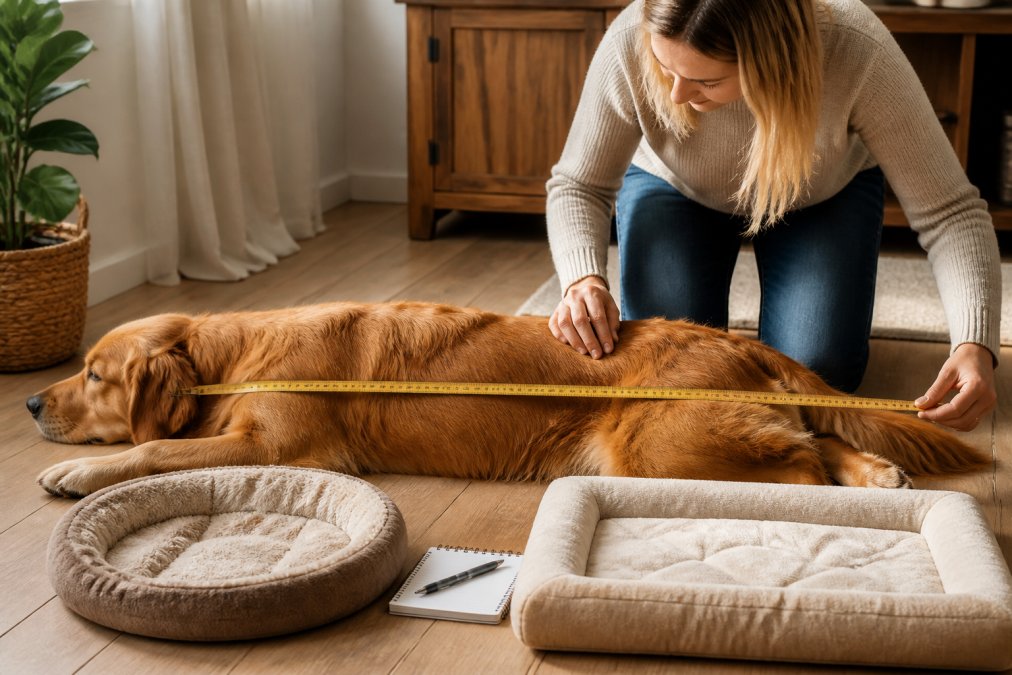
Start by measuring your dog from nose to tail while they're lying in their natural sleeping position. Measure along their back, not in a straight line from above. Next, measure the width across their body at the widest point, typically at the shoulders or hips. Add 6 to 12 inches to both measurements to allow your dog to stretch fully, shift positions, and reposition throughout the night.
Consider your dog's sleeping style. Dogs that like to curl up can use a smaller bed relative to their size. Dogs that stretch out fully need more length. Account for bedding placement in your home, measure the space where you plan to put the bed and select a size that fits comfortably while still accommodating your dog's full length and width.
| Measurement Type | How to Measure | What to Add | Result |
|---|---|---|---|
| Length | Nose to tail while lying flat | 6-12 inches | Minimum bed length |
| Width | Across body at widest point | 6-12 inches | Minimum bed width |
| Space Check | Available floor or furniture space | 2-3 inches clearance | Practical fit in home |
| Comfort Buffer | Dog's full stretch position | 12+ inches for active sleepers | Ideal bed size |
Key Features to Look for in an Orthopedic Dog Bed
Quality orthopedic dog beds share specific features that genuinely improve support and durability.
Foam density is the most critical specification. Measure density in pounds per cubic foot (PCF). High-density memory foam typically ranges from 4.0 to 5.0 PCF, while lower-quality foam falls below 3.0 PCF. Higher density means the foam maintains its shape longer and provides firmer, more consistent support.
Multi-layered construction provides better support than single-layer beds. A quality orthopedic bed typically features a high-density memory foam core topped with a softer comfort layer. The base layer should be firm enough to prevent your dog from sinking through to the floor.
Water-resistant liners protect the foam from accidents and moisture. A quality water-resistant liner prevents urine from soaking into the foam core, which would ruin the bed and create odor issues. Look for liners that are removable and washable.
Bolstered edges provide head and neck support. Dogs naturally like to rest their heads on something, and orthopedic beds with raised edges support the cervical spine. The bolster should be firm enough to provide actual support.
Non-slip base prevents the bed from sliding on hardwood or tile floors. This matters for dogs with mobility issues who need stable footing when getting in and out of bed.
Fabric durability determines how well the bed withstands wear. Quality orthopedic beds use durable, washable fabrics that resist pilling and tearing. Look for fabrics specifically designed for pet use.
Pawsibly Everything offers options like the Pet Sofa Bed, constructed with three-layer suede material and designed for both cats and dogs, featuring removable and washable covers that simplify maintenance.

Pro Tip
Check the foam composition before buying. Beds labeled "memory foam" without density specifications often contain low-quality foam that feels comfortable initially but compresses within weeks. Always look for PCF ratings or density information.
Durability, Washability, and Long-Term Value
An orthopedic dog bed is an investment, and durability directly impacts long-term value. High-density memory foam maintains its supportive properties for 3 to 5 years with proper care. Lower-density foam compresses within 12 to 18 months. When comparing prices, calculate the cost per month of expected use. A $150 bed lasting four years costs about $3 per month, while a $60 bed lasting one year costs $5 per month.
Fabric durability matters equally. Quality pet-grade fabrics resist pilling, tearing, and staining better than standard upholstery. Beds with reinforced seams last significantly longer than those with basic stitching.
Washability impacts both hygiene and longevity. Removable, machine-washable covers simplify cleaning and extend bed life. Look for covers that can handle regular washing without fading or shrinking.
The Round Winter Warm Deep Bed from Pawsibly Everything, priced at $115.99, exemplifies long-term value through its durable polyester and PP cotton construction combined with washable covers. Water-resistant liners protect foam from accidents and spills that would otherwise ruin the bed. Ensure the liner is truly waterproof, not just water-resistant.

Making Your Final Selection
Choosing an orthopedic dog bed requires balancing your dog's health needs, your home's practical constraints, and your budget.
Start with your dog's primary need. Does your dog have diagnosed arthritis or joint issues? If yes, prioritize high-density memory foam with at least 4.0 PCF. Is your dog recovering from surgery? Choose a bed with excellent support and a non-slip base. Is your dog a healthy adult who simply needs comfort? Egg crate foam or lower-density memory foam may meet their needs adequately.
Next, measure your space and your dog. These measurements eliminate beds that won't fit your home or your dog's body. Then consider practical factors: How often will you wash the bed? Does your dog have accidents? Does your dog sleep on hardwood floors? Finally, evaluate durability relative to price by calculating the cost per month of expected use.
The Luxury Plush Dog Sofa Bed for Small Dogs & Cats Comfort at $86.15 offers an accessible entry point for dogs under 30 pounds, combining plush comfort with practical design. For larger dogs or those requiring maximum support, the Pet Sofa Bed at $98.32 provides three-layer construction with enhanced durability. Both options from Pawsibly Everything include removable, washable covers that simplify long-term maintenance.

Give your dog at least a week to settle into their new bed before concluding whether it meets their needs. Watch for improved mobility, reduced stiffness, and signs of comfort. These behavioral changes indicate you've made the right choice.
Key Takeaway
The best orthopedic dog bed is the one your dog will actually use consistently. Consider your dog's preferences, some dogs love bolstered edges while others prefer open designs. Observe your dog's sleeping habits and choose accordingly.
Selecting an orthopedic dog bed becomes significantly easier when you understand what actually matters: foam density, proper sizing, and durable construction. Your dog's comfort during their extended sleeping hours directly impacts their mobility, mood, and overall health. At Pawsibly Everything, we've designed our bed selection to address the specific needs of dogs at every life stage, from young active dogs to senior companions requiring maximum support. Start with our Pet Sofa Bed or Luxury Plush Dog Sofa Bed options, both featuring removable washable covers and supportive construction that keeps your dog comfortable for years to come.
Frequently Asked Questions
What should I look for when buying an orthopedic dog bed?
Focus on high-density memory foam, adequate thickness (at least 4 inches), a supportive core, and water-resistant liners. Check for pressure relief features, proper size for your dog's weight distribution, and durable, washable fabrics. Look for beds with bolstered edges for cervical support and non-slip bases for stability. Quality construction ensures your dog gets real orthopedic support, not just marketing buzzwords.
Do orthopedic dog beds really help dogs with arthritis?
Yes, when properly designed. Orthopedic beds reduce pressure on joints by distributing weight evenly across the surface. Dogs with arthritis benefit from memory foam that conforms to their body, supporting the spine and reducing joint inflammation. The bolstered edges provide additional support for arthritic joints. However, the bed must meet actual orthopedic standards, foam density, thickness, and construction quality matter significantly for therapeutic results.
How do I know if my dog needs an orthopedic bed?
Signs include difficulty rising or lying down, limping or stiffness after rest, visible joint swelling, excessive panting while resting, or reluctance to jump or climb stairs. Senior dogs over 7 years old, large breeds prone to hip dysplasia, and dogs recovering from surgery all benefit from orthopedic support. Even younger dogs with mobility issues, arthritis, or post-surgical needs gain comfort from proper orthopedic bedding that reduces pressure on sensitive joints.
What's the difference between memory foam and egg crate orthopedic beds?
Memory foam provides superior pressure relief by conforming to your dog's body shape and distributing weight evenly, making it better for arthritic joints and senior dogs. Egg crate foam offers airflow and some support but doesn't conform as effectively and may not provide adequate pressure relief for dogs with significant joint issues. Memory foam beds maintain their supportive shape longer and are more durable, though egg crate options work well for younger dogs needing basic orthopedic support at lower price points.
This article was written using GrandRanker

