

Cart
0
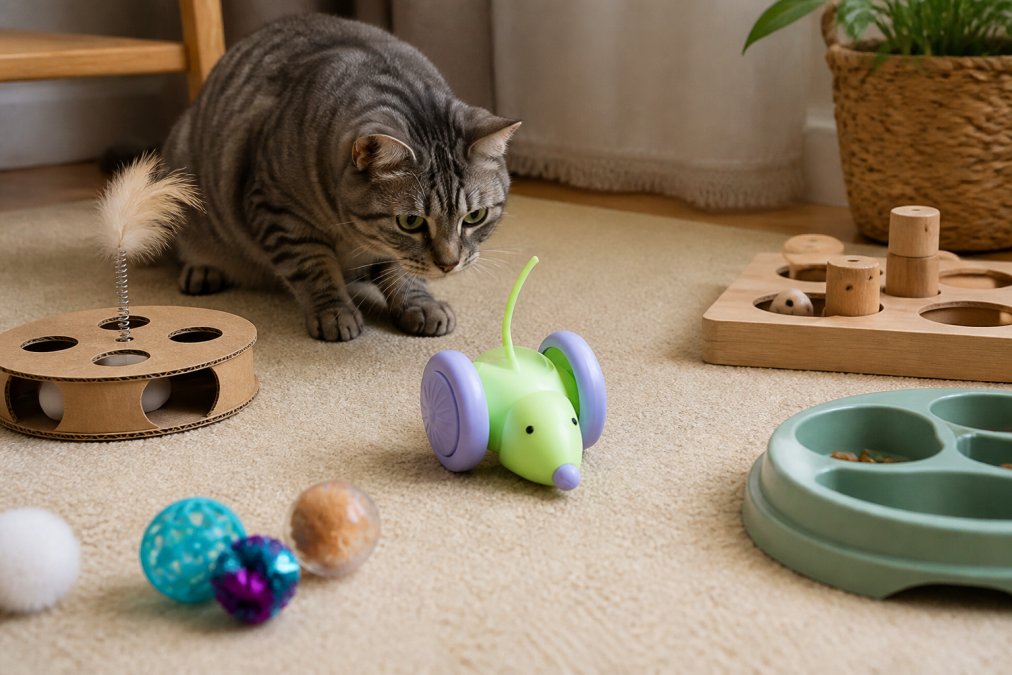
Table of Contents
- Why Mentally Stimulating Cat Toys Matter
- Best Puzzle Feeders for Cats
-
Top 7 Safe Mentally Stimulating Cat Toys
- 1. Interactive Cat Toy - Automatic Moving Touch & Run Mouse Toy
- 2. Self Rolling Cat Toy Ball - Automatic Motion Activated LED
- 3. Electric Automatic Infrared Cat Teaser Toys
- 4. Electric Intelligent Teasing Cat Charging Toys
- 5. Cat Turntable Educational Toys
- 6. Cat Self Congratulating Funny Stick Tumbler Toy
- 7. Pet Movement Playing Teasing Toy
- Cat Toy Safety Guidelines Every Owner Should Know
- How to Rotate Cat Toys for Maximum Engagement
- Electronic vs. Manual Toys for Indoor Cats
- DIY Enrichment Ideas to Complement Store-Bought Toys
- Conclusion
Last Updated: August 20, 2026
Why Mentally Stimulating Cat Toys Matter
Indoor cats without proper mental engagement develop behavioral problems, destructive scratching, excessive vocalization, aggression, and litter box avoidance. A cat's brain is wired for hunting, stalking, pouncing, and foraging. When those instincts go unsatisfied, stress-related issues follow.
Mentally stimulating cat toys tap into natural hunting behaviors, forcing cats to problem-solve, track moving prey, and work for rewards. This cognitive engagement keeps their brain sharp, reduces destructive tendencies, and improves overall temperament. The right enrichment can transform anxious or destructive cats into calmer, more confident companions.
The challenge is finding toys that are safe, durable, and genuinely engaging beyond the first week. This guide breaks down what makes a toy truly enriching and which products deliver on their promises.
Best Puzzle Feeders for Cats
Puzzle feeders transform mealtime into a foraging challenge. Your cat must manipulate the toy to access food, triggering problem-solving skills they'd use hunting in the wild. This slows eating pace, aids digestion, and provides sustained mental stimulation.
The best puzzle feeders combine adjustable difficulty levels with non-toxic, easy-to-clean materials. Look for designs that control how quickly treats dispense, with easier settings for kittens or older cats and harder settings as they master the mechanics. Multi-chamber designs extend play duration better than single-slot models.
The American Animal Hospital Association emphasizes that enrichment toys should match your cat's age and physical ability. Kittens benefit from faster-moving toys, while senior cats need gentler, low-impact options.
Pawsibly Everything carries the Automatic Dog and Cat Treat Dispenser at $17.70. The adjustable exit holes let you control treat flow, and the wobbling motion encourages independent play. Its weight prevents sliding across hardwood floors.
Top 7 Safe Mentally Stimulating Cat Toys
1. Interactive Cat Toy - Automatic Moving Touch & Run Mouse Toy
This toy activates when your cat touches it, instantly darting away to trigger chase sequences. The motion-activated sensor means batteries only drain during active play. The touch-and-run behavior mimics real prey, satisfying the stalk-and-pounce drive.
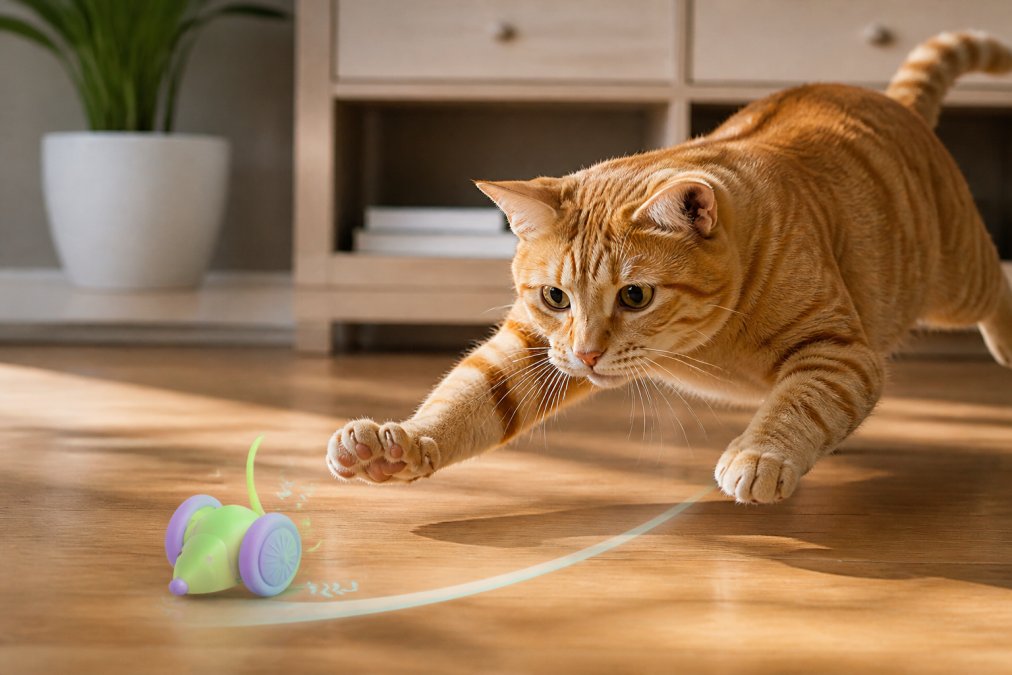
The unpredictability makes this effective. Unlike wand toys that follow human-controlled patterns, this toy moves independently, forcing your cat to read and respond to actual prey-like behavior. The ultra-quiet motor prevents sound-based stress for noise-sensitive cats. The anti-collision body navigates around furniture without getting stuck.
The USB rechargeable design eliminates battery waste. At $7.59, it's an affordable option, ideal for testing whether your cat responds to electronic toys.
Best for: Cats with moderate to high prey drive needing solo play engagement.
2. Self Rolling Cat Toy Ball - Automatic Motion Activated LED
A rolling ball with an internal motor and LED light creates dual sensory stimulation. The obstacle avoidance system prevents the ball from getting stuck under furniture.
The soft silicone exterior reduces noise on hardwood floors and offers bite-resistant texture. The motion-activated design conserves power, and the standby feature wakes instantly when your cat nudges it.
At $11.65, this toy bridges budget-friendly and feature-rich options. The LED light appeals to cats with lower prey drive who respond to visual stimulation. Many cats fixate on the light pattern for extended periods.
Best for: Cats preferring visual stimulation or households with noise restrictions.
3. Electric Automatic Infrared Cat Teaser Toys
Infrared teasing responds to your cat's body heat and movement, creating dynamic, unpredictable play that mimics live prey better than pre-programmed patterns.
The minimalist design fits seamlessly into modern homes. The infrared sensors don't require line-of-sight activation, appealing to cautious or elderly cats who prefer distance-based interaction.
At $37.67, this premium option is justified by sophisticated sensor technology. It works well for multi-cat households where one cat's play style might not trigger motion sensors designed for direct contact.
Best for: Cats with lower confidence, senior cats, and multi-cat households needing independent engagement options.
4. Electric Intelligent Teasing Cat Charging Toys
This orange plastic toy uses intelligent programming to vary movement patterns, preventing predictability that makes cats lose interest. The toy randomizes behavior based on interaction patterns rather than repeating sequences.
The rechargeable design reduces ongoing costs compared to battery-powered alternatives. The intelligent standby mode activates when your cat approaches, conserving power.
At $37.77, it offers different engagement than the infrared model, with more chaotic, less sensor-dependent movement. This works better for cats who've figured out simpler motion-activated toys.
Best for: Experienced play cats and households where variety prevents boredom-related behavior problems.
5. Cat Turntable Educational Toys
The turntable design uses a rotating platform with multiple interactive elements, compartments, and spinning sections that your cat must manipulate to access treats or trigger motion. This combines puzzle-feeder mechanics with active play.
The educational aspect comes from multi-step problem-solving. Your cat must understand cause-and-effect, then remember the pattern for future play. This cognitive challenge distinguishes turntable toys from simple moving toys.
Made from durable PC/ABC plastic, it withstands aggressive play. At $30.39, it delivers both mental and physical stimulation in one toy.
Best for: Intelligent cats with strong problem-solving drive.
6. Cat Self Congratulating Funny Stick Tumbler Toy
The tumbler design uses a weighted base that rights itself when knocked over, inviting repeated pouncing and batting. This satisfies the physical exercise drive alongside mental engagement.
Available in white, green, and pink, it offers visual variety. The HIPS+PC construction provides durability without excessive weight, light enough for kittens to manipulate.
At $15.27, this toy bridges active play and puzzle elements. The self-righting mechanism means extended play without human intervention.
Best for: Kittens and young cats needing high-energy physical play with interactive feedback.
7. Pet Movement Playing Teasing Toy
This retractable wand toy uses a suction-cup base, allowing your cat to trigger play independently without human participation. The retractable design prevents tangling and damage.
The ABS construction keeps it lightweight (41g) while maintaining durability. The suction cup adheres to smooth surfaces like windows or glass doors.
At $12.18, it's affordable and offers the unique advantage of independent wand-toy engagement.
Best for: Cats who enjoy wand-toy play but whose owners work long hours.
Cat Toy Safety Guidelines Every Owner Should Know
All toys should use non-toxic, pet-safe materials. Check for certifications or safety testing information before purchasing. Avoid toys with small detachable parts, loose strings, or sharp edges that could cause choking or internal blockages.
Wand toys and string-based toys should only be used during active play sessions, never left accessible when you're away. Cats can become tangled or swallow string segments, leading to serious intestinal blockages requiring veterinary surgery.
Electronic toys need regular inspection. Check battery compartments for corrosion and ensure USB charging ports remain dry and functional. A malfunctioning toy that sparks or overheats poses burn or electrical hazards.
Toys should be larger than your cat's mouth to prevent choking. Kittens need smaller toys than adult cats, but even small toys should be too large to swallow whole.
Rotating toys prevents boredom and reduces wear and tear. A toy in constant use degrades faster, developing sharp edges or loose parts. Storing toys between rotation cycles extends their lifespan and keeps them safer.
Watch for signs of toy-related injury. Excessive drooling, difficulty eating, vomiting, or lethargy after play suggest your cat may have ingested something harmful. Contact your veterinarian immediately if you notice these symptoms.
Watch Out
String-based toys and toys with detachable parts pose serious choking and intestinal blockage risks. Never leave these toys unsupervised. Linear foreign body obstructions from ingested string often require emergency surgery and can be fatal if not treated quickly.
How to Rotate Cat Toys for Maximum Engagement
Toy rotation prevents habituation, where cats lose interest in toys they see constantly. By cycling toys in and out of availability, you maintain novelty and extend the lifespan of each toy.
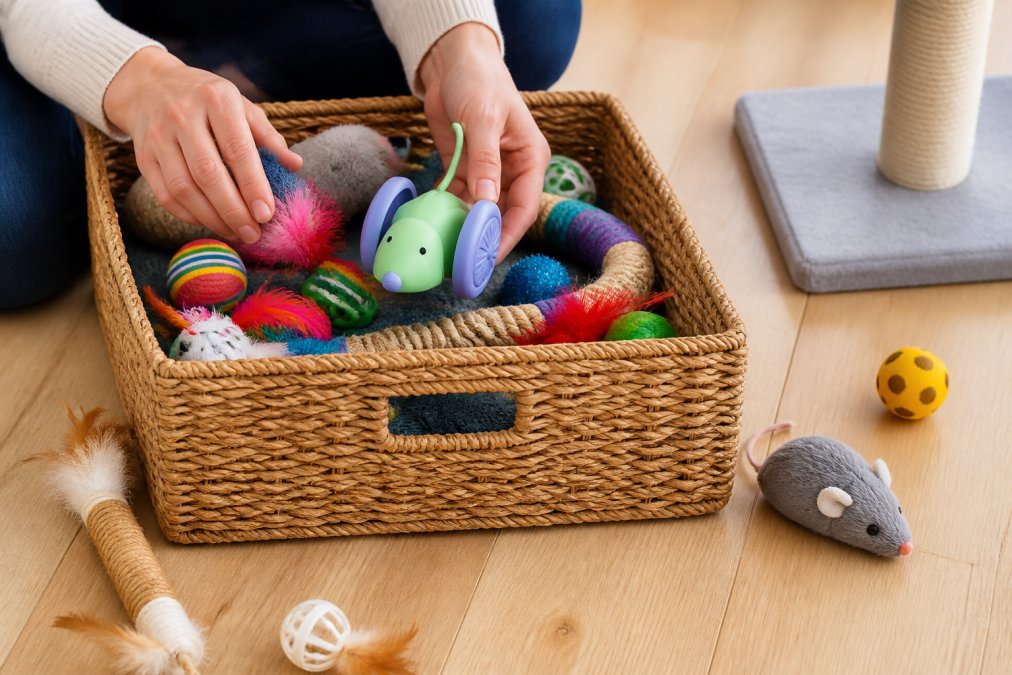
Keep 3-4 toys accessible at any time, store the rest out of sight. Every 1-2 weeks, swap one accessible toy for one from storage. Your cat experiences the "new" toy as genuinely novel, even though you own it already. This costs nothing beyond initial investment and dramatically extends engagement duration.
Track which toys your cat actually uses. Some cats ignore certain types entirely. Focus rotation on toys that generate genuine play behavior.
Store rotated toys in sealed containers to prevent dust accumulation and pest contamination. Check stored toys periodically for damage or degradation.
Pro Tip
Create a toy inventory list noting which toys your cat prefers, when you last rotated them, and any damage or wear. This prevents accidentally offering a damaged toy and helps identify which toys deserve replacement investment.
Electronic vs. Manual Toys for Indoor Cats
Electronic toys offer consistency and independence. Your cat can engage without human participation, making them ideal for busy households or cats with high play drive. Motion-activated sensors conserve battery or charge. The downside: they can malfunction, require charging or battery replacement, and may be too loud for noise-sensitive cats.
Manual toys (wand toys, balls, mice) require human participation but offer superior control and customization. You can adjust play intensity, duration, and direction based on your cat's mood. They never malfunction and require no power source. The limitation: they demand your time and attention.
The best approach combines both. Use electronic toys for independent play during work hours. Reserve manual toys for interactive sessions where you can read your cat's body language and adjust play intensity accordingly.
Consider your cat's age and physical ability. Kittens and young cats thrive with high-intensity electronic toys and vigorous wand-toy sessions. Senior cats benefit from gentler manual toys and lower-impact electronic options that don't require jumping or sustained sprinting.
Noise sensitivity matters more than many cat owners realize. Some cats find electronic toy motors stressful. LED-only electronic toys provide visual stimulation without sound, solving this problem for sensitive cats.
DIY Enrichment Ideas to Complement Store-Bought Toys
Paper bags, cardboard boxes, and crumpled paper offer free enrichment that taps into natural behaviors like hiding and pouncing. Cats are often more entertained by a cardboard box than the toy that came inside it.
Scent-based enrichment uses catnip, silvervine, or valerian root to create novelty and engagement. Sprinkle dried catnip on scratching posts or inside paper bags. Rotate scent toys weekly to prevent habituation.
Water-based enrichment appeals to many cats. A shallow dish of water with floating ping-pong balls or ice cubes provides sensory stimulation. Some cats enjoy batting at ice cubes in their water bowl.
Foraging opportunities mirror natural hunting and feeding behaviors. Hide small portions of food around the house, requiring your cat to search and "hunt" their meals. This extends feeding time and satisfies the foraging instinct.
Window perches create passive enrichment through environmental stimulation. Position a cat bed or shelf near a window where your cat can watch birds and outdoor movement. This "cat TV" provides hours of engagement for many cats.
DIY puzzle feeders use toilet paper tubes, egg cartons, or paper bags filled with treats. Your cat must manipulate the material to access food. These cost nothing and can be replaced frequently.
Key Takeaway
The most effective enrichment combines multiple types: electronic toys for independence, manual toys for interaction, puzzle feeders for cognitive challenge, and environmental enrichment for passive engagement. Variety prevents boredom better than any single toy category.
Conclusion
Safe mentally stimulating cat toys address the core problem most indoor cats face: insufficient mental and physical engagement. The toys covered here, from affordable motion-activated options to premium infrared models, all deliver genuine cognitive benefits when matched to your cat's age, personality, and play style.
The key is matching toy type to your cat's preferences and your household reality. A $7.59 Interactive Cat Toy works brilliantly for some cats while others need the sophisticated programming of the $37.77 Electric Intelligent Teasing Toy. Puzzle feeders like Pawsibly Everything's Automatic Dog and Cat Treat Dispenser ($17.70) provide dual benefits of enrichment and slower feeding.

Rotation, supervision, and material safety prevent toy-related injuries while extending engagement duration. Combine store-bought toys with free DIY enrichment, cardboard boxes, scent toys, and foraging opportunities to create a comprehensive enrichment strategy that keeps your cat mentally sharp, physically active, and behaviorally balanced.
Get started with Pawsibly Everything's curated selection of mentally stimulating cat toys. We've sourced each option specifically for safety, durability, and genuine cognitive engagement. Your cat's mental health depends on it.
| Toy Type | Best For | Engagement Style | Price Range |
|---|---|---|---|
| Motion-Activated Moving Toys | High prey-drive cats | Independent chase play | $7.59-$11.65 |
| Puzzle Feeders | Intelligent cats, slow feeding | Cognitive problem-solving | $17.70-$27.12 |
| Infrared Teasing Toys | Senior or cautious cats | Distance-based interaction | $37.67 |
| Electronic Intelligent Toys | Cats that outgrow simpler toys | Variable, randomized play | $37.77 |
| Turntable Educational Toys | Problem-solving focused cats | Multi-step cognitive challenge | $30.39 |
| Self-Righting Tumbler Toys | Young, high-energy cats | Physical batting and feedback | $15.27 |
| Retractable Wand Toys | Cats preferring human interaction | Controlled play sequences | $12.18 |
Frequently Asked Questions
What makes mentally stimulating cat toys different from regular toys?
Mentally stimulating cat toys engage your cat's natural hunting behaviors, encouraging pouncing, stalking, and foraging. They provide cognitive challenges that prevent boredom and reduce destructive behaviors. Interactive toys with motion sensors, puzzle feeders that require problem-solving, and toys that mimic prey movements all offer mental engagement that standard toys lack, keeping indoor cats physically active and mentally sharp.
Are puzzle feeders safe for cats to use unsupervised?
Most quality puzzle feeders designed specifically for cats are safe for unsupervised play. Look for toys made from non-toxic, food-grade materials without small detachable parts. However, always supervise initial play sessions to ensure your cat understands how to use the toy and won't chew on components. Check the manufacturer's guidelines and inspect toys regularly for wear or damage before each use.
How often should I rotate my cat's toys?
Rotate toys every 1-2 weeks to maintain novelty and prevent boredom. Store half your cat's toys away while keeping the other half accessible. When interest wanes, swap them out. This strategy keeps toys feeling fresh without overwhelming your cat or requiring constant new purchases. Pay attention to which toys your cat gravitates toward most and ensure those favorites rotate back regularly to sustain engagement.
What safety features should I look for in mentally stimulating cat toys?
Prioritize toys made from non-toxic, pet-safe materials without harmful chemicals or dyes. Avoid toys with small parts that can be swallowed, sharp edges, or loose strings longer than 6 inches. Check for secure construction that won't break easily during play. USB-rechargeable toys eliminate battery hazards. Look for toys with obstacle avoidance technology to prevent getting stuck, and ensure any electronic components are properly sealed and durable.
Can I use the same mentally stimulating toys for kittens and adult cats?
Kittens and adult cats have different play needs and energy levels. Kittens benefit from toys encouraging pouncing and stalking with fast movements, while senior cats may prefer gentler, less demanding toys. Electronic toys with adjustable speeds work for multiple ages. Always consider your cat's age, health, and activity level when selecting toys. Supervise kittens more closely with small parts, and choose toys that match your cat's current physical capabilities and interests.
This article was written using GrandRanker

