

Cart
0
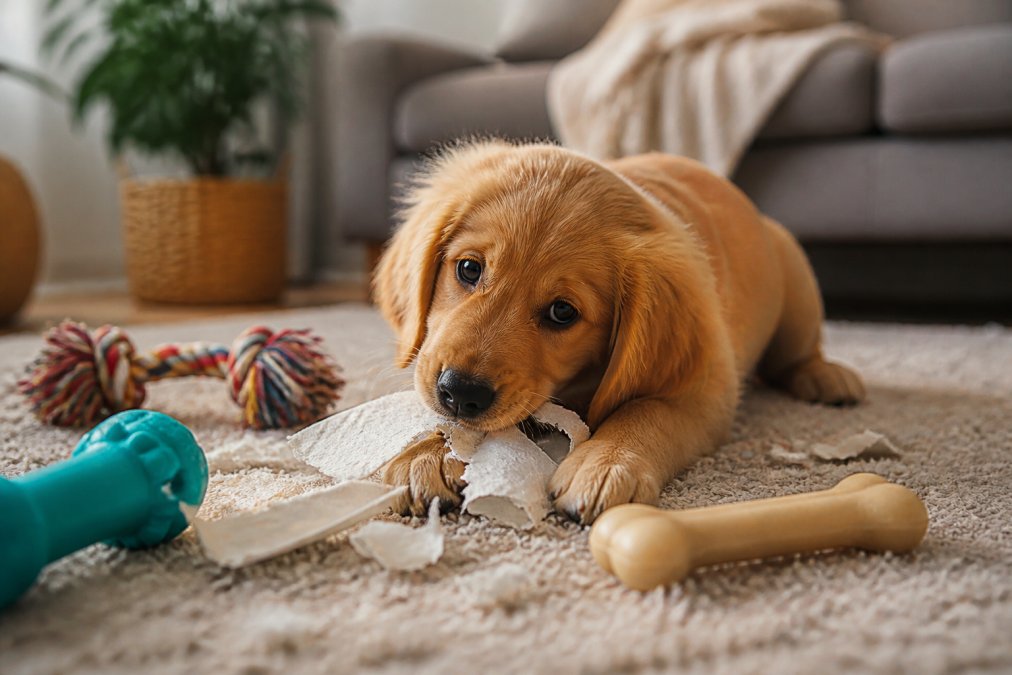
Table of Contents
- Why Puppies Chew on Everything: The Root Causes
- The Puppy Teething Timeline: What to Expect Month by Month
- How to Stop Destructive Chewing: A Step-by-Step Training Plan
- Redirecting Puppy Chewing Behavior: The Redirection Technique in Practice
- Durable Toys for Aggressive Chewers: What Actually Holds Up
- Interactive Enrichment Games That Tire Out Your Puppy
- When to Call Your Vet: Red Flags in Puppy Chewing
- Frequently Asked Questions
Last Updated: September 24, 2026
Why Puppies Chew on Everything: The Root Causes
Puppy chewing solutions start with one simple fact: your puppy is not being bad, and effective puppy chewing solutions begin with understanding why. Chewing is normal puppy behavior that serves real purposes. Most destructive chewing has clear causes you can address. Here's what drives the behavior and how to fix it.
American Veterinary Medical Association guidance on puppy behavior
Teething Discomfort and Oral Pain
Puppies chew to soothe sore gums. Baby teeth start falling out around 12 to 16 weeks, and adult teeth push through by about 6 months. During this window, gnawing on something firm feels good, the same relief a human baby gets from a teething ring.
Boredom and Pent-Up Energy
A tired puppy chews less; a bored puppy chews everything. When young dogs' exercise needs go unmet, they find their own entertainment, sofa corners, remote controls, and baseboards become targets.
The Puppy Teething Timeline: What to Expect Month by Month
The puppy teething timeline maps out the first year so you can prepare instead of react.
| Age | Dental Stage | Chewing Intensity | What Helps |
|---|---|---|---|
| 8-12 weeks | Baby teeth present | Moderate | Soft rubber toys |
| 12-16 weeks | Baby teeth loosen | High | Firm chew toys, cold items |
| 4-6 months | Adult teeth erupt | Peak | Durable rubber, teething toys |
| 6-9 months | Adult teeth settle | Declining | Puzzle toys, enrichment |
| 9-12 months | Full adult teeth | Low to moderate | Daily exercise, training |
How to Stop Destructive Chewing: A Step-by-Step Training Plan
Stopping destructive chewing takes consistency, not punishment. This plan removes temptation, teaches what to chew, and rewards good choices. Most puppies improve within weeks when owners follow all four steps, and most who fail skipped Step 1 and tried to train their way out of a management problem.

Step 1: Puppy-Proof Your Home (Do This First)
Puppy-proofing means removing or blocking anything your puppy shouldn't chew. This environmental management is the fastest way to prevent damage, training cannot outrun a house full of temptations.
- Move shoes, cords, remotes, and phone chargers out of reach, cords are the single most common shock and burn hazard for puppies
- Use baby gates to block off rooms rather than closing doors your puppy can scratch
- Secure trash cans with locking lids; kitchen trash is the top source of foreign-body ingestion
- Spray bitter chew deterrents on furniture legs, but reapply weekly, the taste fades
- Keep bathroom doors closed (toilet paper, medications, and cleaning supplies)
- Move houseplants out of reach; several common ones, sago palm, lily, oleander, and pothos, are toxic to dogs
- Tuck curtain cords and blind pulls up and out of reach
Step 2: Supervise and Confine
Supervision is your best training tool. When you can't watch your puppy, use a crate or small pen; when you can, keep a chew toy within arm's reach.
Step 3: Redirect in the Moment
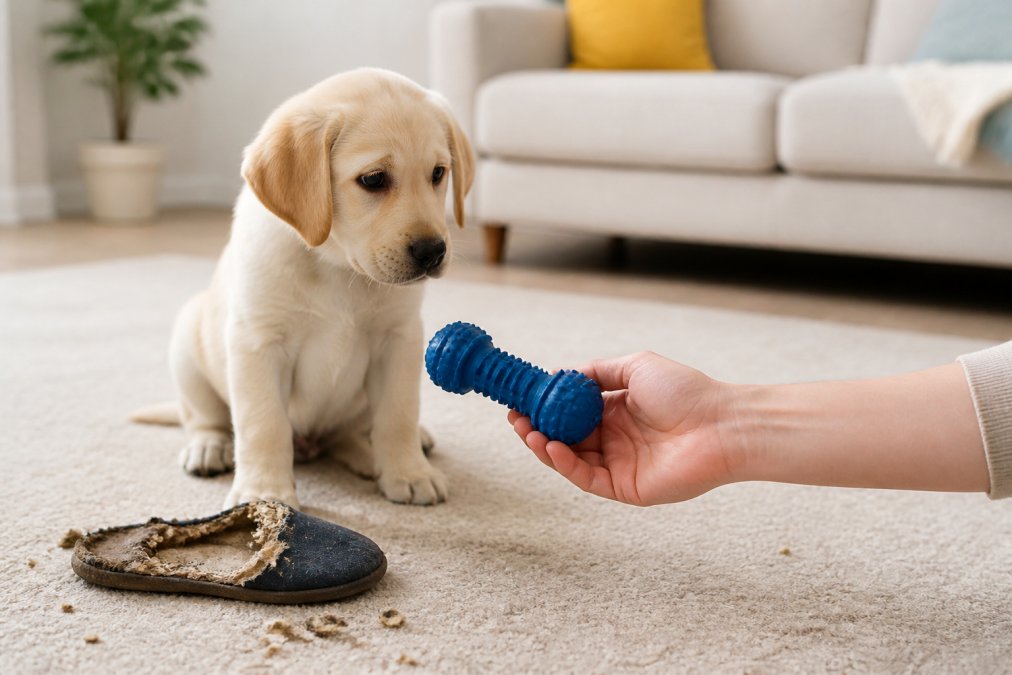
Every time your puppy mouths something off-limits, calmly swap it for an appropriate chew, then praise. This is redirection, and it teaches faster than any correction. The next section breaks it down move by move.
Step 4: Reward the Right Choice Every Time
Positive reinforcement means rewarding the behavior you want. When your puppy chews the right toy, say "yes" and offer a training treat, every time at first, then intermittently once the habit is solid.
Pro Tip
Keep a small jar of training treats in every room. The faster you reward the correct chew, the faster the habit forms. Waiting even 10 seconds weakens the lesson.
Troubleshooting: Why the Plan Sometimes Stalls
- Chewing gets worse, not better. Check exercise and mental stimulation first. An under-exercised puppy cannot be trained out of boredom chewing.
- Puppy only chews when alone. That points to separation-related distress, not a chewing habit. Address the alone-time issue directly.
- Puppy chews the "right" toy for a minute, then goes back to the shoe. You're rewarding too late, or the forbidden item is still more interesting. Rotate toys weekly so they stay novel.
- Puppy eats the toy. Remove and replace it. Anything a puppy can swallow in pieces is a choking and blockage risk.
Breed-Specific Chewing Tendencies
Most guides treat all puppies the same. They aren't. Retrievers, terriers, and herding breeds were developed to work with their mouths and minds, and they chew harder and longer than companion breeds. High-energy working lines often need two to three times the exercise of a lap breed at the same age. If your puppy is from a working or sporting line, plan for more structured activity and more durable chews, and expect a more intense teething peak.
Key Takeaway
If training isn't working after several weeks, and the chewing seems frantic, get a vet check first. Behavior plans fail when an underlying health issue goes untreated.
Redirecting Puppy Chewing Behavior: The Redirection Technique in Practice
Redirecting puppy chewing behavior works best when you act before your puppy loses interest in the swap. The technique has a specific sequence, and timing is what makes it work or fail.
The Four Moves
- Interrupt gently. Say your puppy's name or make a soft kissy sound. Do not yell, clap loudly, or grab, a startle response teaches your puppy to chew in secret.
- Remove the forbidden item without a chase. Slide your hand over the item and pick it up calmly. If your puppy grips it, trade rather than tug.
- Offer an appropriate chew toy immediately. The toy should already be in your hand or pocket. A delay of more than a second or two breaks the association.
- Praise the moment your puppy takes it. Mark the instant the mouth closes on the toy with a calm "yes" and, at first, a treat.
The Timing Rule Most Owners Get Wrong
Redirection only works if the toy arrives before your puppy commits to the forbidden item. Once your puppy is fully engaged, head down, jaw working, body braced, you are interrupting, not redirecting. Interruption is fine as a safety measure, but it doesn't teach the lesson. The teaching happens in the half-second between your puppy noticing the shoe and chewing it.

The Accidental-Reward Trap
Here's the failure mode almost no guide explains: if you offer a treat every time you take something away, your puppy learns that chewing the wrong thing produces a treat. The fix is simple, the reward must follow the toy, not the removal.
- Wrong: puppy chews shoe → you take shoe → you give treat
- Right: puppy chews shoe → you take shoe → you offer toy → puppy takes toy → you mark and reward
What to Do When Redirection Fails
- Puppy ignores the toy. The toy is not high-value enough. Keep a "special" chew that only comes out during redirection drills.
- Puppy turns it into keep-away. Stop chasing. Walk away, wait ten seconds, and offer the toy again from a neutral position.
- Puppy guards the forbidden item. Do not reach in. Trade with a high-value treat tossed a few feet away, then pick up the item once your puppy has moved.
- Puppy redirects onto your hands or clothes. End the interaction calmly, stand up, and turn away for a few seconds. Mouthing on people is a separate behavior and needs its own plan.
Practice It Before You Need It
Set up five short practice reps a day with an item your puppy is allowed to ignore, a sock you don't care about. Place it on the floor, wait for the approach, and run the four moves. Five minutes of daily rehearsal builds the reflex so your hands know what to do when your puppy goes for the real shoe.
Watch Out
Never yank an item from your puppy's mouth. This can turn into a game of keep-away and can damage baby teeth. Trade instead, using a treat or a toy.
Pro Tip
Redirection is not a one-time lesson. Expect to repeat it dozens of times over several weeks before the behavior sticks. Consistency beats intensity.
Durable Toys for Aggressive Chewers: What Actually Holds Up
Durable toys for aggressive chewers share three traits: thick rubber, no small parts, and a shape that resists tearing. Soft plush toys don't last with a determined puppy. That's fine for cuddling, not for chewing.
- Chew Toys For Dog Teeth Cleaning ($6.51): TPR rubber with a serrated surface that cleans teeth and massages gums. The hollow center holds treats.
- Dog Bite Resistant Rubber Grinding Toys ($33.94): Puzzle bone in three sizes. Size S fits dogs under 9 kg, size M covers 7-16 kg, and size L suits 13-30 kg.
- Spiked Dog Chew Toy Stick Dental Cleaning Toy ($18.22): High-density rubber with dental spikes and a squeaker. The center cutout holds peanut butter.
- Vocal Rugby Pet Toys ($15.62): Natural rubber with strong bite resistance for teething and tooth cleaning.
Best For
Puppies in the 4-6 month teething peak who need firm, safe items that clean teeth while they gnaw.
Interactive Enrichment Games That Tire Out Your Puppy
Interactive enrichment games solve boredom at the source. A puzzle feeder or treat ball turns a meal into a job, and a working puppy has no time to chew your furniture.

- Dog Treat Dispenser Ball Toy - Rubber Dental Cleaning & Slow Feeder ($21.89): Natural rubber ball with inner dental spikes. Fill the side slots with kibble and let your puppy roll it.
- Interactive Dog Puzzle Feeder Toy Multi-Function ($27.12): UFO-shaped puzzle with flip lids and sliding channels. Level-two problem solving for smart puppies.
- Dog Treat Dispenser Ball Launcher ($34.23): Gravity-driven, no cords or motors. Drop a tennis ball in the hopper and it rolls out with treats.
- Automatic Dog and Cat Treat Dispenser & Puzzle Feeder ($17.70): Self-balancing astronaut design with adjustable exit holes. Rolls across tile and low-pile carpet.
- Interactive Dog Ball Automatic Moving & Bouncing Toy ($14.89): Motion-activated ball with a rechargeable battery. Smart Mode runs 5 minutes, then rests until your puppy nudges it.
- Slow Feeder Dog Bowls Silicone Dog Puzzle Feeder Bowl ($28.20): Labyrinth bowl that slows mealtime and doubles as a lick mat.
When to Call Your Vet: Red Flags in Puppy Chewing
Some chewing signals a health problem, not a habit. Call your vet if you notice:
- Chewing on walls, rocks, or metal
- Eating non-food items like fabric or plastic
- Drooling, dropping food, or pawing at the mouth
- Sudden chewing in an adult dog
- Weight loss or loss of appetite
Frequently Asked Questions
At what age do puppies stop chewing on everything?
Most puppies outgrow intense chewing between 12 and 18 months, though the worst phase usually ends around 8 to 10 months when adult teeth finish coming in. Teething drives much of the behavior in the first 6 months. After that, chewing often becomes habit or boredom-driven, which means training and enrichment matter more than waiting it out. Consistent redirection and appropriate chew toys speed up the process significantly.
How can I tell if my puppy is chewing due to teething or boredom?
Teething chewing tends to target hard surfaces like furniture legs, baseboards, and shoes, and your puppy may drool or seem uncomfortable. Boredom chewing often happens when your puppy is alone or under-exercised, and they may target random household items. Check the puppy teething timeline: if your puppy is under 6 months, teething is likely. If they are older and chewing escalates when left alone, boredom or separation anxiety is more probable.
What are the best safe materials for puppy chew toys?
Natural rubber, TPR, and high-density non-toxic rubber are the safest choices for puppy chew toys. These materials flex under pressure without splintering like hard plastic can. Avoid rawhide, cooked bones, and antlers, which can crack teeth or cause choking. Look for toys with dental spikes or grooves that clean teeth while your puppy chews. Always match toy size to your puppy's jaw strength and check for wear regularly.
How do I puppy-proof my home to prevent destructive chewing?
Start by getting on your hands and knees to see the room from your puppy's height. Secure electrical cords with cord covers or run them behind furniture. Move shoes, remotes, books, and trash cans out of reach. Use baby gates to block off rooms you cannot supervise. Spray bitter deterrents on furniture legs and baseboards. Provide appropriate chew toys in every room so your puppy always has a legal option within reach.
Puppy chewing can feel endless, but the fix is a mix of patience, the right toys, and a plan you can repeat daily. Pawsibly Everything carries durable chew toys, puzzle feeders, and slow feeder bowls built for exactly this stage, so you can redirect instead of repair. Start with a few tough chew toys and one enrichment puzzle, then build from there. Get started with Pawsibly Everything and give your puppy something better to chew.

