

Cart
0

Table of Contents
- What You'll Need Before Starting Indoor Potty Training
- Comparing Indoor Dog Potty Options
- Step 1: Choose Your Indoor Potty Location
- Step 2: Establish a Puppy Pee Pad Training Schedule
- Step 3: Supervise Your Puppy and Watch for Signals
- Step 4: Use Crate Training and Confinement
- How to Stop a Puppy from Having Accidents Indoors
- Transitioning from Indoor Pottying to Outdoors
- Frequently Asked Questions
Last Updated: October 10, 2026
What You'll Need Before Starting Indoor Potty Training
Indoor potty training puppies requires basic supplies to keep your home cleaner during the process.
Here's what to gather:
- Absorbent pads or newspapers for accidents
- A designated potty area with easy-to-clean flooring
- Enzymatic cleaner to remove odors and prevent repeat accidents
- Crate or playpen for confinement
- Treats and praise supplies for positive reinforcement
- Paper towels and cleaning supplies
Stock up on quality cleaning products and comfortable bedding for your puppy's crate, this foundation makes the entire process smoother.
Pro Tip
Start with more absorbent pads than you think you'll need. Puppies have smaller bladders and need frequent potty breaks. Having extras prevents running out mid-training.
Comparing Indoor Dog Potty Options
Choosing the right indoor potty method depends on your living situation, puppy size, and cleanup preferences. Use this framework to match the best option to your circumstances.
Potty Pads and Newspapers
Potty pads are the most popular choice for indoor potty training puppies. They're affordable, disposable, and work well for apartments.
Best for: Apartment dwellers, puppies under 15 pounds, owners who travel frequently or have unpredictable schedules, and anyone needing a temporary solution during the first 8-12 weeks.
Trade-offs: Pads can create a habit where your puppy thinks any soft surface is acceptable for pottying, complicating the transition to outdoor training.
Transition challenge: If you plan to move to outdoor training, pads may require a longer adjustment period because the potty surface changes dramatically from soft and absorbent to hard ground.
Indoor Grass and Artificial Turf
Indoor grass systems use real or synthetic grass over an absorbent base. Artificial turf lasts 6-12 months and requires no watering; real grass needs weekly watering and replacement every 2-4 weeks.
Best for: Puppies of any size, owners committed to eventually transitioning outdoors, homes with limited yard access, and those willing to invest upfront for a smoother outdoor transition.
Trade-offs: These systems cost $50-$150 upfront (artificial) or $30-$60 per month (real grass), significantly more than pads. Real grass attracts insects and can develop mold in humid climates.
Transition advantage: Puppies trained on grass transition to outdoor potty areas with minimal confusion because the surface remains the same.
Litter Boxes for Puppies
Puppies, especially small breeds, can use litter boxes for a contained, easy-to-clean solution. Choose a large, low-sided box designed for puppies.
Best for: Toy breeds (under 10 pounds), small puppies in their first 6-8 weeks, owners in high-rise apartments, and those with mobility issues that make frequent outdoor trips difficult.
Trade-offs: Litter boxes work best for toy breeds and small puppies; larger puppies outgrow them quickly by 4-5 months. Transition to outdoor training may be more challenging since the potty surface changes dramatically from pellets to grass or concrete.
Transition challenge: Moving from litter to outdoor surfaces requires patient retraining because the sensory experience is completely different.
Decision Matrix
Use this quick reference to narrow your choice:
- Puppy size under 10 lbs + apartment + limited outdoor access → Litter box
- Puppy size 10-30 lbs + apartment + eventual outdoor transition goal → Artificial grass
- Any size + flexibility on budget + fastest setup → Potty pads (short-term)
- Any size + committed to outdoor transition + willing to invest → Artificial grass
- Any size + budget-conscious + willing to replace frequently → Potty pads
Key Takeaway
The best indoor potty option matches your living space, puppy size, and long-term training goals. Pads suit most situations and offer flexibility, grass appeals to puppies' natural instincts and eases outdoor transition, and litter boxes work for small breeds in tight spaces but require more dramatic surface changes later.
Step 1: Choose Your Indoor Potty Location
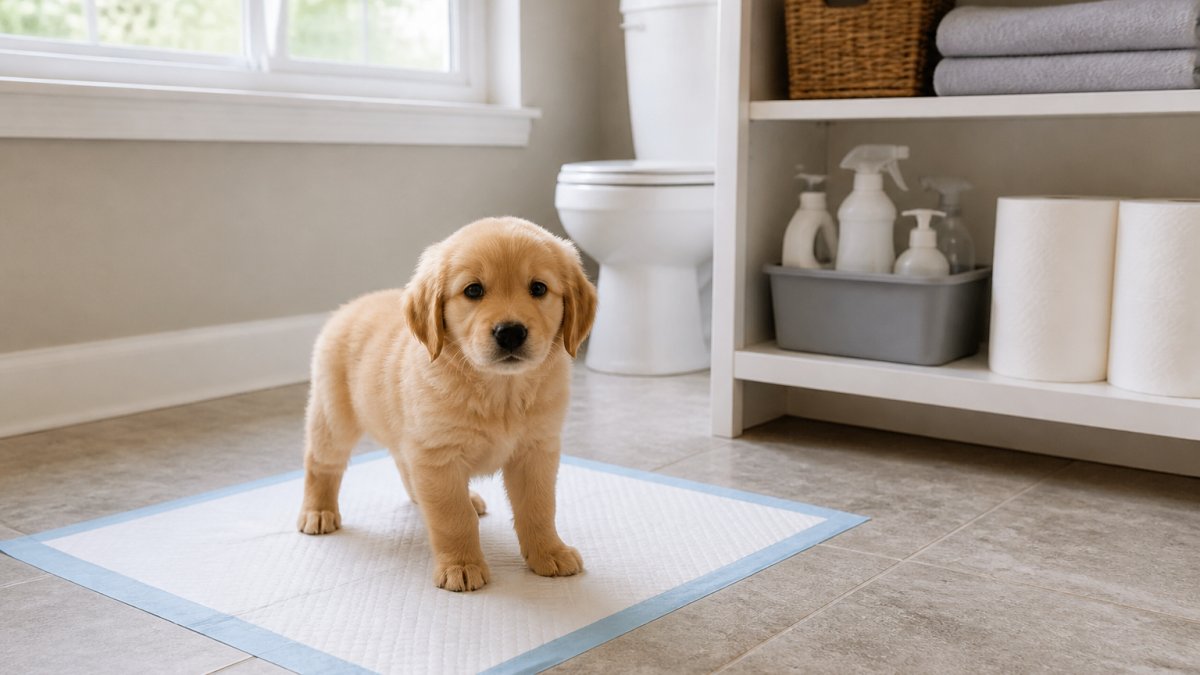
Pick a spot that's easily accessible, away from your puppy's sleeping and eating areas. Bathrooms, laundry rooms, or kitchen corners work well, they have hard flooring that's easy to clean. Avoid carpeted areas; accidents leave lingering odors that encourage repeat accidents. Ensure the area is well-lit and quiet so your puppy feels safe.
Step 2: Establish a Puppy Pee Pad Training Schedule
Consistency is everything for indoor potty training puppies. Puppies need frequent potty breaks, typically every 1-2 hours during the day, plus after meals, naps, and playtime.
Create a simple schedule:
- First thing in the morning
- After every meal (usually 15-30 minutes later)
- After playtime or excitement
- Before bedtime
- During the night if your puppy is very young
Young puppies can hold their bladder for roughly one hour per month of age. A 2-month-old puppy needs a potty break every 2-3 hours.
Write down potty times and track accidents. Patterns emerge quickly, helping you adjust the schedule to your puppy's natural rhythm.
Watch Out
Skipping scheduled potty breaks is the #1 reason puppies have accidents indoors. Consistency prevents confusion and teaches your puppy that the designated area is the only acceptable potty spot.
Step 3: Supervise Your Puppy and Watch for Signals
Keep your puppy in sight during all waking hours. Learn your puppy's signals: sniffing, circling, whining, or pausing during play. The moment you see these signals, carry your puppy to the potty area immediately.
When your puppy uses the potty area correctly, reward instantly with praise and treats. Use the same phrase every time: "Good potty!" This creates a clear association. Puppies respond to immediate positive reinforcement far better than delayed praise.
Step 4: Use Crate Training and Confinement
Crate training works because puppies naturally avoid soiling their sleeping space. A properly sized crate becomes a powerful training tool. When you can't actively supervise, place your puppy in the crate to prevent accidents and build bladder control.
Use the crate during:
- Nighttime sleep
- When you leave the house
- During meals and training breaks
- Anytime you cannot watch your puppy
Never use the crate as punishment. Make it a positive space with comfortable bedding and a favorite toy. Your puppy should view the crate as a safe den.
Let your puppy out and head straight to the potty area. This routine creates a powerful habit: crate → potty → playtime.
How to Stop a Puppy from Having Accidents Indoors
Accidents happen, even with perfect training. How you respond, both behaviorally and through proper cleanup, determines whether your puppy learns from them or repeats the behavior in the same spot.
Behavioral Response to Accidents
What NOT to do:
- Never punish or yell at your puppy for accidents
- Don't rub their nose in it or show anger
- Avoid making them fear you or potty time
Punishment teaches puppies to hide when they need to go, not to use the designated area. It damages trust and often increases anxiety-related accidents.
What TO do:
- Stay calm and neutral
- Interrupt mid-accident gently and carry your puppy to the potty area immediately
- If they finish there, praise immediately with your training phrase: "Good potty!"
- If the accident is already complete, simply clean it up without comment
Puppies don't connect punishment to past accidents, they only understand immediate consequences. Yelling after the fact teaches fear, not bladder control.
Sanitation and Odor Prevention: The Critical Step
This is where most indoor training fails.
Why regular cleaners don't work:
Urine contains uric acid crystals that persist after the liquid dries. Standard cleaners remove visible stains but leave uric acid behind.
How enzymatic cleaners work:
Enzymatic cleaners contain biological enzymes that break down uric acid crystals at a molecular level, eliminating the scent marker entirely.
Step-by-step cleanup protocol:
-
Blot, don't wipe. Use paper towels or cloth to absorb as much liquid as possible. Press firmly to pull moisture into the towel. Wiping spreads urine across a larger area.
-
Apply enzymatic cleaner generously. Saturate the affected area and a 6-inch radius around it. The enzyme needs contact with all urine residue, including what has soaked into subflooring or grout.
-
Let it sit. Follow the product instructions, most require 10 minutes to several hours of contact time. During this window, enzymes actively break down uric acid. Do not rush this step.
-
Blot again. After the contact time, blot up excess cleaner with fresh paper towels.
-
Allow to air dry completely. Enzymes continue working as the area dries. This may take 24 hours. Do not apply heat or additional cleaners during this time, as they can deactivate enzymes.
-
For stubborn spots or multiple accidents in one location, repeat the enzymatic treatment. Heavily soiled areas may need two applications.
Product selection:
Look for cleaners labeled "enzymatic" that specifically target pet urine. Products containing protease and amylase are most effective. Avoid ammonia-based cleaners, which can smell like urine to dogs and may encourage repeat accidents in that spot.
Special surfaces:
- Hardwood or laminate: Use wood-formulated enzymatic cleaners. Apply sparingly and blot frequently.
- Carpet: Require thorough blotting to prevent mold. Consider renting a wet-dry vacuum to extract moisture.
- Tile and grout: May need multiple treatments or grout-specific enzymatic products.
- Concrete: May require multiple applications and longer contact times.
Identifying Patterns and Adjusting Your Routine
If accidents cluster at specific times or locations, your puppy is telling you something:
- Same location, different times → Lingering odor may be present. Re-treat with enzymatic cleaner or move the potty area closer.
- Same time, different locations → Your schedule doesn't match your puppy's natural rhythm. Adjust potty breaks to match their biology.
- Accidents during sleep or confinement → Your puppy's bladder may not be mature enough for the current holding time. Reduce crate time or increase potty breaks.
- Accidents during play or excitement → Take your puppy to the potty area before and after intense play sessions.
Watch Out
Skipping enzymatic cleanup is the #1 reason puppies have repeat accidents in the same spot. Even one missed cleanup can restart the cycle. Consistency in both supervision and sanitation prevents confusion and teaches your puppy that the designated area is the only acceptable potty spot.
Transitioning from Indoor Pottying to Outdoors
Most puppies are ready to move primarily outdoors by 4-6 months old. Start introducing outdoor potty time around 3-4 months using the same schedule and phrase: "Good potty!" Gradually reduce indoor pads over 5+ weeks. Some regression is normal, stay patient and increase outdoor breaks if accidents increase. By 6 months, most puppies have solid outdoor habits.
Best For
Puppies in apartments or homes without immediate yard access benefit most from indoor potty training methods. These puppies eventually transition to outdoor training, but starting indoors prevents weeks of holding their bladder in stressful situations.
Indoor potty training puppies requires patience, consistency, and the right supplies. Success depends on choosing a method that fits your living situation, sticking to a strict schedule, and responding to accidents calmly. Start with a clear plan, supervise closely, and remember that every puppy learns at their own pace.
Frequently Asked Questions
How often should a puppy use an indoor potty?
Puppies need frequent bathroom breaks. Young puppies (8-12 weeks) typically need to go out every 1-2 hours, plus after eating, playing, and napping. By 4-6 months, they can extend to every 3-4 hours. Establishing a consistent indoor potty training schedule helps your puppy develop bladder control and reduces accidents indoors significantly.
Are puppy pads a good idea for potty training?
Potty pads work well for apartment dwellers and busy owners, but they can confuse puppies about where it's acceptable to eliminate. Some puppies think any soft surface is a potty area. Pads work best as a temporary solution during the initial indoor potty training phase, with a clear plan to transition to outdoor pottying within a few months.
How do you transition a puppy from pee pads to going outside?
Start by gradually moving the potty pad closer to the door over 1-2 weeks. Then place it outside temporarily. Once your puppy reliably uses it outdoors, remove the pad entirely and take your puppy to that same spot on a regular schedule. Reward heavily with praise and treats when they go outside. This gradual transition from indoor pottying to outdoors prevents confusion and setbacks.
What should I do if my puppy keeps having accidents indoors?
Accidents happen during house training. Never punish your puppy, as this creates fear and confusion. Instead, clean accidents thoroughly with enzymatic cleaner to remove odor, which prevents repeat accidents in the same spot. Increase supervision, stick to your schedule, and ensure your puppy has consistent access to their designated potty area. Regression is normal; patience and consistency resolve most indoor accidents.

