

Cart
0
Table of Contents
- Why Durable Dog Toys Matter for Puppy Development
- How to Assess Your Puppy's Chewing Style and Jaw Strength
- Safe Materials for Puppy Chew Toys
- Best Durable Dog Toys for Aggressive Chewers
- Sizing Toys Correctly for Your Puppy's Breed and Age
- How to Clean Dog Toys and Spot Wear Before It's Dangerous
- Toy Rotation and Age-Specific Durability: What Most Owners Miss
- Frequently Asked Questions
Last Updated: September 22, 2026
Why Durable Dog Toys Matter for Puppy Development
A puppy's first year is a demolition derby. Teething, jaw development, and instinctive gnawing all converge, and a toy that shreds in ten minutes isn't just a waste of money. It's a choking hazard waiting to happen.
This guide from Pawsibly Everything walks through how to choose durable dog toys for puppies by matching material, size, and hardness to your specific dog's chewing style. Get it right and you'll spend less, clean up fewer shredded messes, and protect your puppy's developing teeth.
Durable dog toys are chew products built from materials that resist puncturing, tearing, and fragmenting under repeated jaw pressure. The right one redirects destructive behavior onto a safe target instead of your baseboards.
What most guides get wrong: they rank toys by "toughness" alone. Durability without a size and hardness match is how puppies crack molars or swallow fragments.
[ASPCA pet care guidance on safe chew toys(/products/chew-toys-for-dog-teeth-cleaning) | aspca.org]
How to Assess Your Puppy's Chewing Style and Jaw Strength
Watch your puppy for one week before buying anything. The American Kennel Club notes that chewing intensity varies dramatically by breed and individual, so observation beats guessing.
Rate your puppy on these four signals:
- Destruction speed: How fast does a soft toy lose a limb?
- Pressure marks: Do indentation marks stay in firm rubber after a session?
- Molar focus: Does your puppy work the back teeth rather than nibble with the front?
- Attention span: Does one toy hold interest for 20 minutes or 2?
Score each 1 to 3. A total of 9 or above means you're shopping for power-chewer territory.
Power Chewers vs. Gentle Players: What's the Difference?
Power chewers apply sustained jaw pressure and gnaw through soft toys within minutes. Gentle players nibble, carry, and mouth toys without destroying them. The difference is jaw strength plus motivation, not size, and it decides which materials will survive.
Safe Materials for Puppy Chew Toys
Safe materials for puppy chew toys share three traits: non-toxic formulation, flex under pressure, and no splintering. Materials that shatter into sharp fragments are the ones that send puppies to the vet.
The three you'll see most often:
- Natural rubber: Flexes and rebounds. Best for teething puppies and moderate chewers.
- Nylon: Very hard, very long-lasting. Better for determined gnawers past the baby-teeth stage.
- TPR (thermoplastic rubber): Softer than nylon, tougher than latex. Good middle ground for teething.
Natural Rubber, Nylon, and TPR: Which Holds Up Best?
| Material | Durability | Best For | Watch Out For |
|---|---|---|---|
| Natural rubber | Moderate-high | Teething, gentle to moderate chewers | Can be punctured by strong molars |
| Nylon | Very high | Power chewers, adult teeth | Too hard for young puppies |
| TPR | Moderate | Teething puppies, texture variety | Wears down faster than nylon |
Watch Out
Handing a hard nylon toy to a puppy still cutting baby teeth can chip or fracture those teeth. Match hardness to developmental stage, not to how tough your puppy looks.
Best Durable Dog Toys for Aggressive Chewers
The best durable dog toys for aggressive chewers combine a firm-but-flexible material with a shape that survives sustained gnawing. Look for solid construction, no small detachable parts, and a texture that massages gums rather than abrading them.
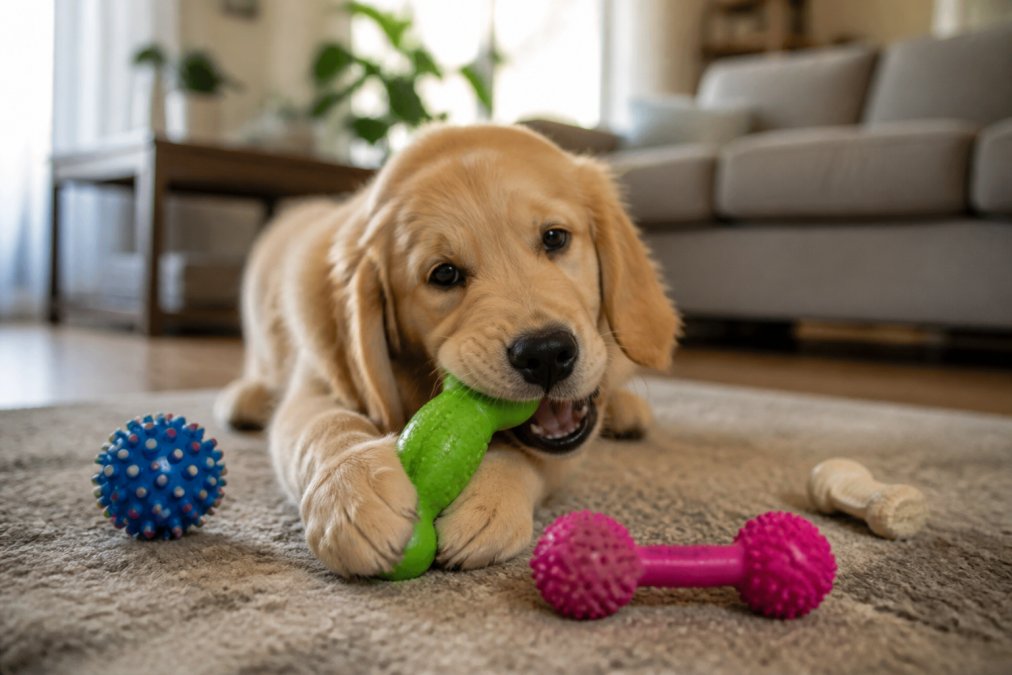
Pawsibly Everything's Dog Bite Resistant Rubber Grinding Toys come in three puzzle-bone sizes: S for dogs under 9kg, M for 7-16kg, and L for 13-30kg, which makes matching a growing puppy straightforward. For teething puppies, the Chew Toys For Dog Teeth Cleaning use TPR with a serrated surface designed to clean teeth and massage gums.


Pro Tip
Freeze a TPR teething toy for 30 minutes before giving it to a puppy. The cold numbs sore gums, and the material stays flexible enough not to crack.
Sizing Toys Correctly for Your Puppy's Breed and Age
Size-appropriate toys prevent the two most common injuries: swallowing and jaw strain. A toy that's too small disappears down the throat. One that's too large strains the jaw and gets abandoned.
Use a two-point test instead of eyeballing it:
- Width test: The toy should be wider than your puppy's muzzle at its widest point. Measure muzzle width with a soft tape across the lips, not the nose.
- Protrusion test: With the toy in your puppy's mouth, both ends should stick out past the closed lips. If either end disappears, the toy is a swallow risk.
Age-Specific Durability Progression
Most guides treat "puppy" as one stage. It isn't. Jaw strength and tooth development change fast enough that the toy that worked at four months can fail at eight.
- 8-16 weeks (baby teeth, sore gums): Soft natural rubber and TPR. The goal is relief, not resistance. Hard nylon can chip or fracture baby teeth.
- 4-6 months (teething peak, baby teeth loosening): Slightly firmer TPR and textured rubber. Cold or frozen toys help here because the cold numbs gums and the material stays flexible.
- 6-9 months (adult teeth erupting): Transition to firmer rubber. This is when most owners upgrade too early to nylon and see gum irritation.
- 9-12 months and beyond (adult teeth set, jaw strength climbing): Hard rubber and nylon become appropriate. This is the stage where "power chewer" products actually fit.
Pro Tip
When in doubt, size up rather than down. A slightly oversized toy gets abandoned; an undersized one gets swallowed.
How to Clean Dog Toys and Spot Wear Before It's Dangerous
Clean dog toys weekly with warm water and a pet-safe soap, then inspect them at the same time. Cleaning is your built-in inspection window, and it's how you catch a toy before it becomes a hazard.
What Wear Actually Looks Like, and Why It Matters
Different materials fail in different ways, and the failure mode tells you how urgent the replacement is:
- Cracks and gouges in rubber or TPR: The material has lost its rebound. Once a crack forms, jaw pressure widens it, and small fragments can break off.
- Deep punctures in natural rubber: A puncture is a stress point. It will tear along the puncture line under continued chewing.
- Loose or missing squeakers: The squeaker is the single most common swallowed component. If it rattles or shifts, retire the toy.
- Fraying rope ends or exposed seams: Rope fibers and stuffing are both impaction risks once they separate from the toy body.
- Any piece that pulls away when you tug it: This is the tug test. If a component separates with light hand pressure, it will separate under jaw pressure.
Cleaning by Material
- Rubber and TPR: Dishwasher top rack on a low-heat cycle, or hand wash with warm water and pet-safe soap. Skip the heated dry cycle.
- Nylon: Scrub with a stiff brush and warm soapy water, then air-dry. Nylon is porous enough that it holds odor if it isn't fully dried.
- Rope: Rope toys harbor bacteria once frayed. Replace rather than repair them, and don't put them in the dishwasher.
- Plush with squeakers: Spot clean only. If the plush is torn enough to expose stuffing, it's done.
Tie Cleaning to Rotation
This is the part most guides skip. Cleaning and rotation work together. If you keep four to six toys available and swap a third of them out every few days, each toy gets a rest period, and you get a natural inspection window every time a toy comes back into the rotation.
Key Takeaway
Inspect every toy during its weekly wash and again when it re-enters rotation. A toy that fails the tug test today is a choking hazard tomorrow, and replacement costs far less than an emergency vet visit.
Toy Rotation and Age-Specific Durability: What Most Owners Miss
Rotating toys preserves novelty and stretches durability. Keep four to six toys available, swap a third of them out every few days, and store the rest out of sight. Puppies treat a returning toy as new, which means fewer destroyed toys and more mental stimulation from the ones you own.
AVMA guidance on pet dental health and chewing
Frequently Asked Questions
What materials are safest for puppy chew toys?
Natural rubber, TPR, and high-density nylon are among the safest options for puppy chew toys. These materials flex under pressure rather than splintering, which reduces choking hazards. Look for toys labeled non-toxic and BPA-free. Avoid toys made from cheap plastic that can crack into sharp pieces. Pawsibly Everything's Dog Bite Resistant Rubber Grinding Toys use durable rubber designed to withstand aggressive chewing while being gentle on teeth and gums.
How can I tell if a dog toy is durable enough for my puppy?
Check the toy's material density and look for wear indicators within the first few play sessions. If you see deep gouges, cracks, or pieces breaking off, the toy is not durable enough. Power chewers need toys rated for aggressive chewing, like the Spiked Dog Chew Toy Stick made from high-density non-toxic rubber. Rotate toys regularly and inspect them weekly for damage to keep your puppy safe.
At what age should I start giving my puppy durable chew toys?
Puppies can start using durable chew toys as early as 8 to 10 weeks old, once they begin teething. Choose softer rubber toys at first to protect developing teeth, then progress to harder materials as jaw strength increases around 4 to 6 months. Always supervise playtime and match toy size to your puppy's breed to prevent swallowing risks.
How do I clean dog toys to keep them safe?
Most rubber and TPR toys can be washed with warm water and pet-safe soap, then rinsed thoroughly and air-dried. For tougher grime, soak toys in a vinegar and water solution for 10 minutes. Check manufacturer instructions, since some toys with squeakers or fabric components may need spot cleaning only. Clean toys weekly to reduce bacteria buildup and extend their lifespan.
Choosing durable dog toys for puppies comes down to one honest assessment of your dog's chewing style, then matching material and size to it. Pawsibly Everything stocks the chew toys, grooming tools, and comfort essentials that make that job simpler, with a curated range built around pet well-being rather than shelf space. Browse the collection, add to cart, and give your puppy a toy that survives the week.

