

Cart
0
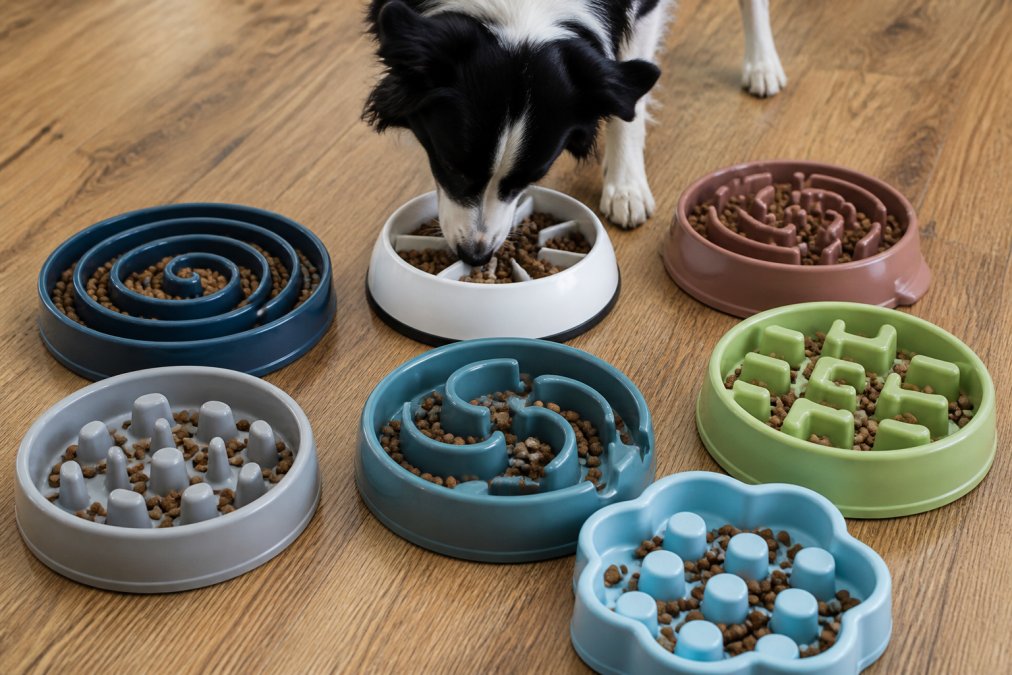
Table of Contents
- Quick Comparison: Best Slow Feeders for Dogs at a Glance
- How We Chose These Slow Feeders: Our Evaluation Criteria
- Benefits of Slow Feeder Dog Bowls: Why Your Dog Needs One
-
The 9 Best Slow Feeders for Dogs Reviewed
- 1. Outward Hound Fun Feeder Slo-Bowl: Best Overall Maze Feeder
- 2. KONG Wobbler: Best for Physical and Mental Enrichment
- 3. LickiMat: Best for Anxious Dogs and Wet Food
- 4. Neater Feeder with Stainless Steel Slow Feed Bowl: Best for Senior or Arthritic Dogs
- 5. Northmate Green Interactive Feeder: Best for Foraging Instincts
- 6. OurPets IQ Treat Ball: Best Adjustable Puzzle Feeder
- 7. Snuffle Mat: Best for Scent Work and Foraging
- 8. Hyper Pet IQ Treat Mat: Best Lick Mat for Portion Control
- 9. Petstages Slurp & Crunch Bowl: Best Budget Maze Bowl
- Slow Feeder vs. Puzzle Toy for Dogs: Which One Does Your Dog Actually Need?
- How to Stop a Dog from Eating Too Fast: Choosing and Using the Right Feeder
- Material Safety, Dishwasher Safety, and Durability: What to Check Before You Buy
- Which Slow Feeder Should You Pick? A Simple Decision Framework
Last Updated: August 4, 2026
Choosing the best slow feeders for dogs is one of the highest-impact decisions you can make for your dog's digestive health. Fast eating causes gulping, bloat, regurgitation, and long-term digestive issues. Below, we'll show you exactly which feeders work for which dogs, what materials to trust, and the one transitioning mistake that turns a helpful tool into a frustrating chore.
Quick Picks:
- Best Overall: Outward Hound Fun Feeder Slo-Bowl - ideal maze design for most dogs
- Best for Anxious Dogs: LickiMat - calming lick action reduces mealtime anxiety
- Best for Senior Dogs: Neater Feeder with Stainless Steel Slow Feed Bowl - elevated, ergonomic, mess-proof
- Best Budget Option: Petstages Slurp & Crunch Bowl - simple, effective, easy to clean
- Best for Mental Enrichment: KONG Wobbler - physical and cognitive challenge in one
Quick Comparison: Best Slow Feeders for Dogs at a Glance
| Product | Type | Best For | Dishwasher Safe | Price Range |
|---|---|---|---|---|
| Outward Hound Fun Feeder Slo-Bowl | Maze bowl | Fast eaters, most breeds | Top rack | $3.50 - $19.99 |
| KONG Wobbler | Wobbler/dispenser | Mental enrichment, active dogs | Yes | $9.99 - $23.99 |
| LickiMat | Lick mat | Anxious dogs, wet food | Yes | $7.99 - $26.99 |
| Neater Feeder with Stainless Steel Bowl | Elevated feeder | Senior/arthritic dogs | Partial | $41.99 - $74.99 |
| Northmate Green Interactive Feeder | Foraging feeder | Natural foraging instincts | Yes | $28.99 - $38.99 |
| OurPets IQ Treat Ball | Puzzle ball | Adjustable challenge, active dogs | Yes | $13.99 - $24.99 |
| Snuffle Mat | Scent/foraging mat | Scent work, mental stimulation | Machine wash | $14.99 - $43.90 |
| Hyper Pet IQ Treat Mat | Lick mat | Portion control, soft food | Top rack | $7.50 - $18.99 |
| Petstages Slurp & Crunch Bowl | Maze bowl | Budget buyers, simple setup | Yes | $7.82 - $15.99 |
How We Chose These Slow Feeders: Our Evaluation Criteria
Every product was evaluated against four criteria: material safety, cleaning practicality, effectiveness at slowing eating speed, and suitability across different dog sizes and temperaments. Material safety came first, any feeder that isn't confirmed BPA-free, phthalate-free, and food-grade didn't make the cut. According to FDA guidance on food contact materials, food-grade plastics must meet specific safety thresholds for leaching.
Cleaning practicality matters more than most reviews admit. A slow feeder that takes 20 minutes to scrub gets abandoned within a week. We prioritized products that are top-rack dishwasher safe or machine washable. Effectiveness was judged by design complexity and whether it genuinely extends mealtime. Finally, we assessed breed and size suitability, including challenges for flat-faced breeds and deep-chested dogs prone to gastric dilatation-volvulus.
Benefits of Slow Feeder Dog Bowls: Why Your Dog Needs One
A slow feeder dog bowl is designed with ridges, mazes, or obstacles that force a dog to work around barriers to access food, extending mealtime from seconds to several minutes.
Preventing Bloat, GDV, and Digestive Issues
Gastric dilatation-volvulus is a life-threatening emergency in which the stomach fills with gas and twists on itself. Deep-chested and large breeds face the highest risk. According to American Kennel Club's veterinary health resources, breeds like Great Danes, Standard Poodles, Weimaraners, and German Shepherds are statistically more vulnerable to GDV than smaller breeds.
Slow feeders directly address the root cause by eliminating rapid gulping that introduces excess air into the digestive tract. Reducing gulping also decreases regurgitation, a common complaint from owners of fast-eating dogs.
Watch Out
Never feed a deep-chested or giant breed dog from a standard bowl at floor level without a slow feeder. The combination of fast eating and improper bowl height dramatically increases GDV risk. If your dog bloats, it is a veterinary emergency requiring immediate care.
Mental Enrichment and Cognitive Stimulation at Mealtime
Slow feeders are puzzle feeders by another name. Every meal becomes a problem-solving session that engages food motivation, scent detection, and spatial reasoning. Interactive feeding through a maze design or snuffle mat can add 10-15 minutes of focused cognitive activity to each meal. This matters most for high-energy breeds, dogs with mealtime anxiety, and pets that exhibit destructive behaviors between meals.
The 9 Best Slow Feeders for Dogs Reviewed
1. Outward Hound Fun Feeder Slo-Bowl: Best Overall Maze Feeder
The Outward Hound Fun Feeder Slo-Bowl combines genuine maze complexity with food-grade material safety and a non-slip base. The maze-style design features ridges that can slow eating by up to 10x compared to a standard bowl. Multiple sizes cover dogs from toy breeds to large dogs. The bowl is top-rack dishwasher safe, and the BPA, PVC, lead, and phthalate-free construction means no chemical exposure.
Aggressive chewers can damage the plastic ridges over time, and complex patterns may frustrate anxious eaters.
Pros: Variety of maze patterns and sizes; top-rack dishwasher safe; food-grade materials Cons: Plastic not ideal for power chewers; complex patterns may frustrate some dogs
Best For
Most dogs under 70 lbs who eat kibble too quickly and need an accessible, affordable starting point for slow feeding.
2. KONG Wobbler: Best for Physical and Mental Enrichment
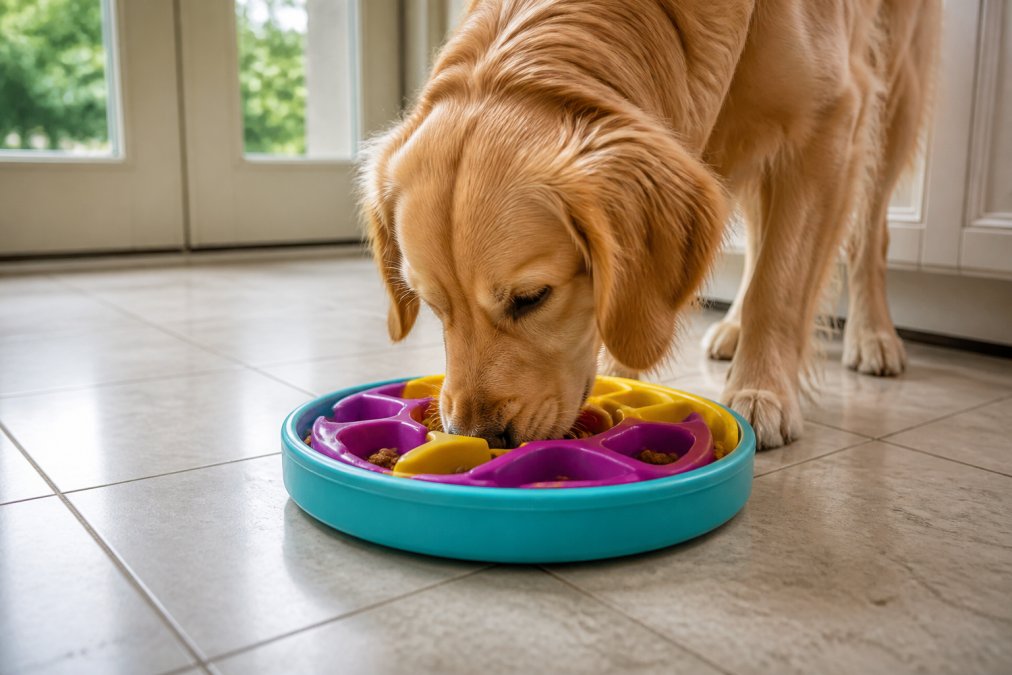
The KONG Wobbler turns every meal into a physical and cognitive challenge by dispensing kibble unpredictably as the dog nudges it across the floor. Made in the USA, it unscrews for easy filling and is dishwasher safe. The limited capacity requires refilling mid-meal for large dogs, but the durable construction and unpredictable wobble action provide superior enrichment.
Pros: Durable construction; provides physical exercise alongside mental enrichment; dishwasher safe Cons: Limited capacity for large meals; can frustrate dogs new to puzzle feeders
3. LickiMat: Best for Anxious Dogs and Wet Food
The LickiMat uses a textured surface that holds soft food in tiny pockets, forcing repetitive licking that releases calming endorphins. For dogs with mealtime anxiety or stress-related fast eating, this is the most targeted solution. The mat works best with wet food, yogurt, peanut butter, or soft treats. It's freezer safe, allowing you to prep portions ahead and hand them to your dog as a long-lasting enrichment activity.
The LickiMat is not a replacement for a kibble slow feeder. For dogs on a dry kibble diet, pair it with a maze bowl.
Pros: Calming licking action; freezer safe for extended use; aids dental hygiene through increased saliva Cons: Not suitable for dry kibble as a primary feeder; standard version not durable for aggressive chewers
4. Neater Feeder with Stainless Steel Slow Feed Bowl: Best for Senior or Arthritic Dogs
The Neater Feeder solves two problems: the elevated design reduces joint strain on older dogs with arthritis, and the stainless steel slow feed bowl with a raised center portion slows eating without awkward bending. The patented two-part design separates spilled food from water, keeping the feeding area clean. Optional leg extensions adjust height as your dog's needs change.
Pros: Elevated position reduces joint strain; mess-proof design; durable stainless steel bowl; BPA-free Cons: Higher price than standalone feeders; bulky footprint
5. Northmate Green Interactive Feeder: Best for Foraging Instincts
The Northmate Green Interactive Feeder replicates natural foraging behavior by requiring dogs to hunt through grass-like plastic tines to find their food. It works with both dry and wet food and is dishwasher safe. The intricate grass-like structure is difficult to clean thoroughly by hand, so run it through the dishwasher every time.
Pros: Highly effective at slowing eating; engages natural foraging instincts; works with wet and dry food Cons: Difficult to hand-clean; not ideal for very flat-snouted breeds
Pro Tip
For brachycephalic breeds like French Bulldogs or Pugs, choose a feeder with wider, shallower channels rather than deep tines or narrow maze ridges. Flat-faced dogs struggle to reach food in tight spaces, which causes frustration rather than enrichment.
6. OurPets IQ Treat Ball: Best Adjustable Puzzle Feeder
The OurPets IQ Treat Ball offers adjustable difficulty, allowing you to start with easy dispensing and gradually increase the challenge as your dog figures it out. It twists apart for cleaning and encourages both mental stimulation and physical activity. It is noisy on hard floors and not built for aggressive chewers.
Pros: Adjustable learning levels; engages dogs mentally and physically; easy to clean Cons: Noisy on hard floors; not suitable for aggressive chewers
7. Snuffle Mat: Best for Scent Work and Foraging
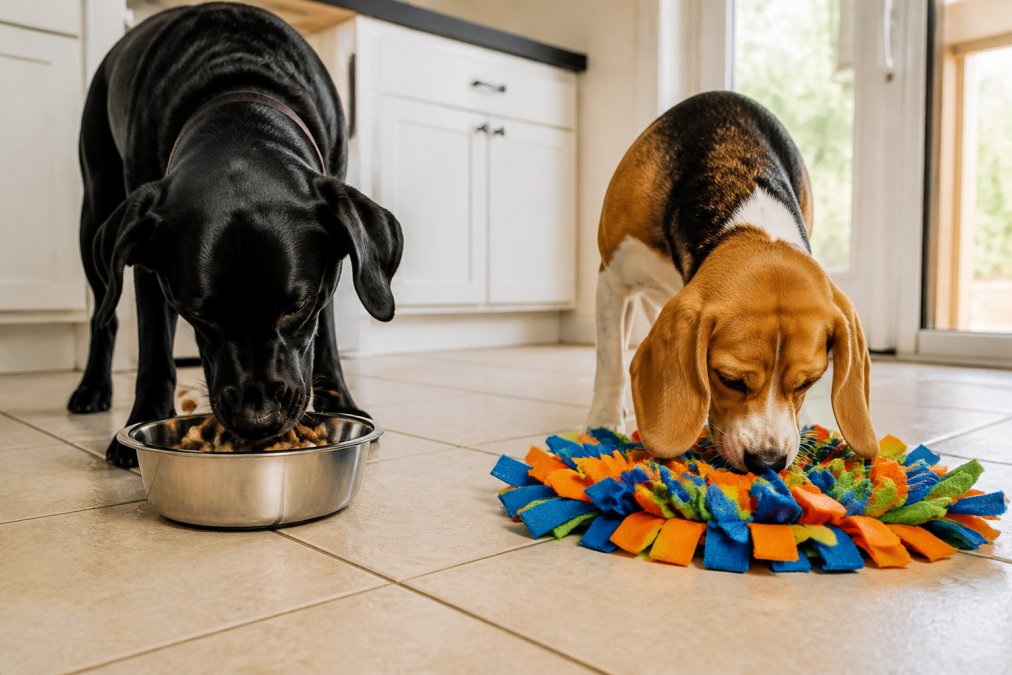
The snuffle mat is the most sensory-rich option. Fabric strips and hidden pockets require a dog to use their nose to locate kibble, engaging scent work at a level that maze bowls cannot replicate. Many dogs find this more tiring than physical exercise. The machine-washable construction is a genuine advantage over hard plastic feeders, though fabric is vulnerable to determined chewers.
Pros: Engages natural scent work; machine washable; mentally tiring for high-energy dogs Cons: Not suitable for aggressive chewers; more effort to clean than hard bowls
8. Hyper Pet IQ Treat Mat: Best Lick Mat for Portion Control
The Hyper Pet IQ Treat Mat distinguishes itself through its quadrant design, which helps guide portion control by providing four distinct sections to fill. Made in the USA and top-rack dishwasher safe, it's one of the cleaner options in the lick mat category. Like all lick mats, it's optimized for soft foods rather than dry kibble. The calming effect of repetitive licking makes it particularly useful during grooming, vet visits, or thunderstorm anxiety.
Pros: Quadrant design aids portion control; calming licking action; top-rack dishwasher safe; made in the USA Cons: Not a primary kibble feeder; not intended for aggressive chewers
9. Petstages Slurp & Crunch Bowl: Best Budget Maze Bowl
The Petstages Slurp & Crunch Bowl delivers the core function of a slow feeder without unnecessary complexity. Unique maze patterns slow down eating, the materials are pet-safe, and the bowl is dishwasher safe. You trade less mental stimulation than puzzle feeders and fewer size and pattern options than the Outward Hound range. For a pet parent testing slow feeding before committing to a more complex feeder, this is the right starting point.
Pros: Effective at slowing mealtime; easy to clean; affordable entry point Cons: Less mental enrichment than puzzle feeders; fewer design options
Slow Feeder vs. Puzzle Toy for Dogs: Which One Does Your Dog Actually Need?
A slow feeder is a feeding vessel that physically restricts access to food during meals. A puzzle toy is an interactive enrichment device that a dog engages with outside of structured mealtime. If your dog eats too fast and you're concerned about bloat, regurgitation, or digestive health, a slow feeder bowl or wobbler used at every meal is the right solution. If your dog is under-stimulated, anxious between meals, or needs cognitive exercise, a puzzle toy addresses behavioral health more directly.
Several products on this list do both. The KONG Wobbler, OurPets IQ Treat Ball, and Northmate Green Interactive Feeder function as slow feeders during mealtime and as enrichment tools when loaded with treats. For most dogs, one primary slow feeder for meals and one puzzle toy for between-meal enrichment is the practical answer.
How to Stop a Dog from Eating Too Fast: Choosing and Using the Right Feeder
Stopping a dog from eating too fast requires matching the feeder type to the dog's specific eating behavior, breed characteristics, and food type.
Breed-Specific Challenges: Flat-Faced, Deep-Chested, and Giant Breeds
Brachycephalic breeds like French Bulldogs, Bulldogs, and Pugs need feeders with wide, shallow channels. Deep tines, narrow maze ridges, and tight puzzle compartments physically prevent these dogs from accessing their food. For flat-faced dogs, lick mats and wide-channel maze bowls are the most accessible options.
Deep-chested breeds, including Great Danes, Boxers, Dobermans, and Standard Poodles, face the highest GDV risk. For these dogs, an elevated feeder combined with a slow feed bowl is the veterinarian-recommended approach. The Neater Feeder with Stainless Steel Slow Feed Bowl is purpose-built for this combination. According to Veterinary Emergency Group's guide to GDV in dogs, immediate veterinary intervention is critical if a large-breed dog shows signs of bloat after eating.
Giant breeds like Great Danes and Saint Bernards need feeders with sufficient capacity to hold a full meal. A wobbler or treat ball that requires constant refilling mid-meal creates frustration.
Transitioning Your Dog to a Slow Feeder Without Frustration
The most common mistake when introducing a slow feeder is going from a standard bowl to the most complex feeder immediately. Dogs that have eaten from standard bowls their entire lives find high-difficulty feeders confusing and may refuse to eat.
Start with the lowest-complexity option: a wide-channel maze bowl or a shallow snuffle mat. Let the dog succeed easily for the first week, then gradually introduce more complex feeders. For puzzle feeders like the KONG Wobbler or OurPets IQ Treat Ball, start with the easiest difficulty setting and increase it only after the dog is confidently engaging.
Some dogs need the feeder placed on a non-slip mat to prevent sliding. Others benefit from a small amount of food placed on top of the maze ridges initially to show them where the food is. Patience in the first two weeks prevents the feeder from becoming a source of mealtime anxiety.
Pro Tip
For dogs that refuse a new slow feeder entirely, try rubbing a small amount of peanut butter or wet food into the maze ridges before adding kibble. The scent and taste cue triggers food motivation and gets the dog engaged with the new feeder format.
Material Safety, Dishwasher Safety, and Durability: What to Check Before You Buy
Material safety is the most under-discussed factor in slow feeder reviews. Every feeder that contacts your dog's food should be confirmed food-grade, BPA-free, and free from phthalates, PVC, and lead. Check the manufacturer's product page for explicit material certifications.
Dishwasher safety varies by product. Most hard plastic slow feeders are top-rack dishwasher safe only. High heat from the bottom rack can warp plastic ridges and compromise the non-slip base. Stainless steel bowls tolerate full dishwasher cycles more reliably. Fabric snuffle mats are machine washable but should air dry to prevent mildew.
Durability splits along two lines: material hardness and design complexity. Plastic feeders with intricate maze designs are more vulnerable to aggressive chewing than simple maze bowls. For power chewers, stainless steel or the LickiMat Tuff version are more durable. The KONG Wobbler benefits from KONG's reputation for heavy-duty construction.
Before purchasing any slow feeder, verify: confirmed BPA-free and food-grade materials, dishwasher safe or machine washable construction, non-slip base or suction cup, size-appropriate capacity for your dog's full meal portion, and appropriate complexity level for your dog's experience with slow feeders.
Which Slow Feeder Should You Pick? A Simple Decision Framework
The right slow feeder depends on three variables: your dog's eating behavior, their physical characteristics, and the food type you're serving.
| Dog Type | Primary Concern | Best Feeder Choice |
|---|---|---|
| Fast eater, any breed | Gulping and bloat prevention | Outward Hound Fun Feeder Slo-Bowl |
| Anxious dog | Mealtime anxiety, calming | LickiMat or Hyper Pet IQ Treat Mat |
| Senior or arthritic dog | Joint strain, elevated feeding | Neater Feeder with Stainless Steel Bowl |
| High-energy breed | Mental enrichment, stimulation | KONG Wobbler or Snuffle Mat |
| Deep-chested/giant breed | GDV risk reduction | Neater Feeder elevated + slow bowl |
| Flat-faced breed | Accessible maze design | Wide-channel maze bowl or lick mat |
| Budget-conscious buyer | Simple, effective slow feeding | Petstages Slurp & Crunch Bowl |
| Adjustable challenge needed | Progressive difficulty | OurPets IQ Treat Ball |
| Natural foraging instincts | Scent work engagement | Northmate Green or Snuffle Mat |
If your dog is a fast eater without specific breed concerns, start with the Outward Hound Fun Feeder Slo-Bowl. If you have a senior dog with joint issues or a deep-chested breed with GDV risk, the Neater Feeder is the most medically sound choice. For behavioral health and anxiety, lick mats and snuffle mats outperform maze bowls because the licking and foraging actions directly reduce stress hormones. The best slow feeders for dogs are the ones that match your specific dog's needs. As documented in ASPCA guidance on canine enrichment and feeding, feeding enrichment that matches a dog's natural behaviors produces the best outcomes for both physical and behavioral health.
Fast eating is a genuine health risk, not a quirk to tolerate. The right slow feeder addresses bloat risk, supports canine nutrition, and turns every meal into a moment of mental enrichment. At Pawsibly Everything, our curated selection of pet supplies is built around exactly this principle: every product should actively improve your pet's well-being. Explore our range of interactive feeding solutions and premium pet supplies to find the right fit for your dog, and Add to Cart when you're ready to make mealtime work harder for your pet's health.
Frequently Asked Questions
Are slow feeders actually good for dogs?
Yes. Slow feeders reduce gulping, which lowers the risk of regurgitation and digestive discomfort. For deep-chested breeds especially, rapid eating is associated with gastric dilatation-volvulus (GDV), a life-threatening condition. Beyond physical health, slow feeders add cognitive stimulation at mealtime, which helps reduce boredom-driven behaviors. Veterinarians commonly recommend them for fast eaters, food-motivated dogs, and breeds genetically prone to bloat. The right feeder depends on your dog's size, snout shape, and food type.
What type of slow feeder is best for dogs?
The best type depends on your dog's eating style and food. Maze-design bowls like the Outward Hound Fun Feeder work well for dry kibble and most breeds. Wobblers like the KONG Wobbler add physical activity. Lick mats and LickiMats suit wet food and anxious dogs. Snuffle mats engage natural foraging instincts. Flat-faced breeds such as Bulldogs do better with shallow maze patterns or snuffle mats rather than deep-ridged designs that make it hard for them to reach food.
Can slow feeders help prevent bloat in dogs?
Slow feeders address one of the key risk factors for bloat and gastric dilatation-volvulus (GDV): eating too fast and swallowing excess air. By forcing dogs to work around ridges, mazes, or dispensing mechanisms, these feeders significantly reduce gulping. While no single product eliminates GDV risk entirely, especially in genetically susceptible breeds like Great Danes and German Shepherds, slowing mealtime is a practical, veterinarian-recommended step toward better digestive health.
Are slow feeder bowls dishwasher safe?
Many are, but placement matters. The Outward Hound Fun Feeder, KONG Wobbler, Northmate Green Interactive Feeder, Hyper Pet IQ Treat Mat, and Petstages Slurp & Crunch Bowl are all listed as dishwasher safe, though most specify top-rack only. Always check the manufacturer's instructions before using high heat. For BPA-free plastic feeders, top-rack washing at lower temperatures preserves the material longer. Stainless steel options like the Neater Feeder bowl are generally the most durable under repeated washing.
How do I transition my dog to a slow feeder without frustrating them?
Start with the easiest maze pattern or the largest opening on a puzzle feeder so your dog gets rewarded quickly. For the first week, use the slow feeder for only one meal per day. Add a small amount of wet food or a high-value treat to the feeder to build positive associations. Gradually increase difficulty as your dog grows comfortable. Dogs that show signs of giving up or pawing aggressively at the feeder need a simpler design before progressing to more complex puzzle feeders.
This article was written using GrandRanker

