

Cart
0

Table of Contents
- Why Interactive Toys Matter for Your Kitten's Development
- Physical Health Benefits: Building Strength and Coordination
- Mental Stimulation for Kittens: Sharpening Their Minds
- Emotional Well-Being: Reducing Anxiety and Preventing Boredom
- How Long Should I Play With My Kitten? A Practical Schedule
- Safe Kitten Toys for Unsupervised Play: What to Look For
- Choosing the Right Interactive Toys for Your Kitten
- Frequently Asked Questions
Last Updated: September 26, 2026
Why Interactive Toys Matter for Your Kitten's Development
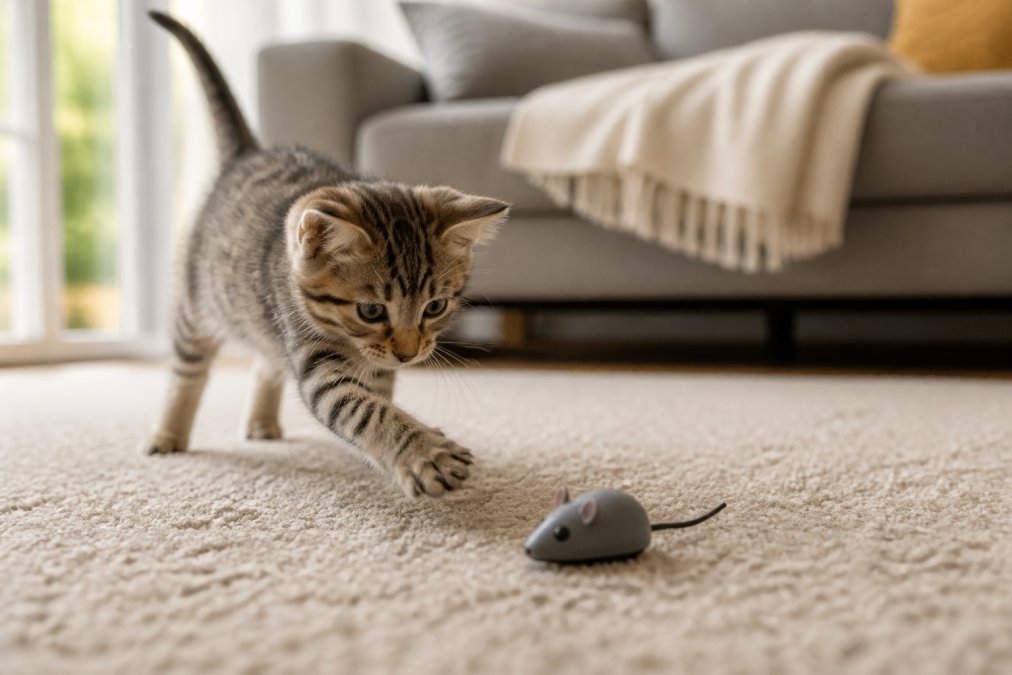
Interactive toys for kittens are motion-activated or hands-on play objects that trigger a cat's natural hunting sequence: stalk, chase, pounce, and catch. They matter because kittens build coordination, confidence, and social skills through play, not through passive observation. At Pawsibly Everything, we hear the same thing from new pet parents: a bored kitten becomes a destructive kitten.
Key Takeaway
A kitten that gets 20-30 minutes of active, interactive play per day tends to settle faster at night and shows fewer boredom-driven behaviors like biting hands or climbing curtains.
Physical Health Benefits: Building Strength and Coordination
Regular active play supports weight management, muscle tone, and cardiovascular health in growing kittens. The physical benefits show up quickly: better balance, sharper coordination, and stronger hind legs from all that pouncing.
Here's what's happening under the fur:
- Muscle tone develops through repeated jumping, twisting, and landing.
- Balance and coordination improve as kittens learn to judge distance mid-leap.
- Cardiovascular health benefits from short bursts of high-intensity chasing.
- Obesity prevention starts early, since an active kitten is far less likely to become a sedentary adult.
Mental Stimulation for Kittens: Sharpening Their Minds
Mental stimulation for kittens is any activity that requires problem-solving, tracking, or decision-making. Puzzle feeders, motion toys, and wand play all qualify because they engage the predatory drive rather than just the paws.
Pro Tip
Rotate toys in and out of a closed drawer rather than leaving everything on the floor. The reappearance of a "forgotten" toy often gets a stronger reaction than a brand-new one.
Emotional Well-Being: Reducing Anxiety and Preventing Boredom
Interactive play reduces stress and prevents the boredom that drives most unwanted kitten behaviors. Scratching furniture, biting hands, and nighttime zoomies are usually boredom symptoms, not personality flaws. But the mechanism matters, because understanding why play works tells you how to use it.
The predatory drive does not disappear
Play therapy works because it gives a kitten an outlet for its predatory drive. Without that outlet, the drive does not vanish. It redirects onto your ankles, your curtains, or your houseplants. A kitten that has stalked, chased, pounced, and caught something during the day is a kitten whose hunting circuit has been satisfied. That satisfaction is what produces the calm, settled behavior owners actually want.
Kitten-specific anxiety triggers
Kittens are not small cats. Their anxiety profile is different, and it changes fast during the first several months:
- Separation from littermates and mother. A kitten adopted at 8 to 10 weeks is still learning that being alone is safe. Short, predictable play sessions with you become a substitute for the rough-and-tumble play it would have had with siblings.
- New environments. A move, a new piece of furniture, or a loud appliance can spike a kitten's stress. A familiar wand toy used in the new space gives the kitten a predictable, controllable activity.
- Sudden noises. Vacuum cleaners, blenders, and thunderstorms are common triggers. A quiet, self-contained motion toy lets a kitten engage on its own terms without adding noise to the room.
- Changes in routine. Kittens thrive on predictability. Feeding, play, and sleep at roughly the same times each day reduces baseline anxiety more than any single toy.
What boredom actually looks like
Owners often miss the early signs and only notice once a behavior has become a habit. Watch for:
- Chewing on cords, shoes, or furniture corners
- Ambushing feet or hands from under furniture
- Excessive meowing at night or in the early morning
- Over-grooming, especially bald patches on the belly or inner legs
- Climbing curtains, shelves, or anything vertical
- Repeatedly knocking objects off surfaces
The human-animal bond
The bond strengthens through play too. A kitten that associates you with exciting, unpredictable movement becomes more confident and more attached. That bond pays off for years, and it is the foundation for handling, vet visits, and grooming later in life. A kitten that trusts you during play is a kitten that trusts you during a nail trim.
Structured play for anxious or high-energy kittens
For high-energy or anxious kittens, structured play sessions are one of the most effective behavior tools available. Pair them with a predictable routine, and most owners notice calmer evenings within a couple of weeks. The key word is structured: same times, same order, same wind-down. Random play helps, but scheduled play changes behavior.
Pro Tip
If your kitten is anxious, end every session the same way: a catch, then a small treat or meal. The predictable ending teaches the kitten that the exciting thing always resolves calmly. That predictability is what lowers baseline anxiety over time.
How Long Should I Play With My Kitten? A Practical Schedule
Most kittens do best with two to three play sessions per day, each lasting 10 to 15 minutes. Aim for a total of 20 to 45 minutes of active play daily, adjusting for your kitten's age and energy level. That range is a starting point, not a rule. The right number depends almost entirely on how old your kitten is, because a kitten's attention span, coordination, and sleep needs change dramatically between 8 weeks and 6 months.
Play by developmental stage
8 to 12 weeks (2-3 months): Attention spans are short and coordination is still clumsy. Aim for four to six micro-sessions of 3 to 5 minutes each, spread across the day. Wand toys dragged low along the floor work better than fast aerial teasers, because a kitten this age is still learning to track and pounce. Expect frequent breaks mid-session.
A sample daily schedule
| Session | Time of Day | Duration (3-4 mo kitten) | Best Toy Type |
|---|---|---|---|
| Morning | After breakfast | 5-10 min | Wand or teaser toy |
| Mid-day | Before nap | 5 min | Puzzle feeder or turntable |
| Late afternoon | After nap | 5-10 min | Motion-activated toy |
| Evening | Before bed | 10-15 min | Wand or motion toy |
Adjust the durations up or down based on your kitten's age. A younger kitten gets more sessions at shorter lengths; an older kitten gets fewer, longer ones.

End every session with a catch
Let your kitten win. That completes the prey sequence (stalk, chase, pounce, catch) and signals that playtime is over, which makes the wind-down easier. A kitten that never catches anything stays keyed up and may redirect that frustration onto hands or ankles.
Signs of overstimulation: when to stop
This is the part most guides skip, and it matters more than any schedule. Kittens do not always walk away when they have had enough. They escalate. Stop play immediately if you see any of these:
- Dilated pupils that stay wide even in normal light
- Flattened ears or ears rotated sideways (often called "airplane ears")
- A twitching or lashing tail
- Skin rippling along the back
- Sudden biting or swatting at your hand instead of the toy
- Freezing mid-play, then staring at you
Watch Out
Never use your hands or fingers as toys, even during gentle play. A kitten that learns hands are prey carries that habit into adulthood, and adult cat bites send people to urgent care every year.
Safe Kitten Toys for Unsupervised Play: What to Look For
Safe kitten toys for unsupervised play are toys with no loose strings, no small detachable parts, and no batteries a kitten can reach. If your kitten will be alone with a toy, it needs to be sturdy, quiet, and self-contained.
Look for these qualities:
- No choking hazards: nothing smaller than your kitten's mouth that can come loose.
- No long cords or ribbons: these tangle easily and can wrap around a leg or neck.
- Motion-activated and self-contained: toys that turn on and off on their own keep a kitten engaged without you present.
- Quiet motors: sudden loud noises can startle a young kitten and create a negative association with play.
- Rechargeable power: avoids the hassle and expense of disposable batteries.
Watch Out
Never leave a wand toy with a string unattended. A kitten can get a paw or jaw caught in the cord within seconds, and the injury risk is real. Wands are for supervised play only.
Choosing the Right Interactive Toys for Your Kitten
The best interactive toys for kittens match your kitten's energy level, your schedule, and your tolerance for noise. There's no single "best" toy, but there is a best toy for each situation.
Best For
New pet parents who work from home and need a kitten occupied during meetings, plus anyone who wants a quiet, rechargeable option instead of a drawer full of dead batteries.
Frequently Asked Questions
How long should I play with my kitten using interactive toys?
Aim for two to three play sessions per day, each lasting 10 to 15 minutes. Kittens have short attention spans but high energy, so shorter, frequent sessions work better than one long one. Watch for signs your kitten is losing interest, like walking away or lying down. Always end on a positive note with a treat or praise so playtime stays enjoyable.
Are battery-operated toys safe for unsupervised kitten play?
Some are, but you need to choose carefully. Look for toys with no small parts that can be chewed off, no exposed wires, and quiet motors that won't startle your kitten. The Interactive Cat Toy with motion-activated sensors and an anti-collision body is designed to navigate safely around furniture. Even with safe toys, check on your kitten periodically during solo play.
Do interactive toys help with kitten behavioral issues?
Yes. Interactive toys provide an outlet for natural hunting instincts, which reduces boredom-related behaviors like scratching furniture, biting hands, and nighttime zoomies. A kitten that gets regular mental and physical stimulation from interactive play is calmer and less likely to act out. Combining interactive toys with positive reinforcement training gives the best results for behavioral health.
What are the best types of interactive toys for high-energy kittens?
Motion-activated toys that move unpredictably, like the Automatic Moving Touch & Run Mouse Toy, work well because they trigger the prey sequence. USB-rechargeable options save money on batteries and provide long-lasting play. Rotate between two or three different toys each week to prevent boredom and keep your kitten engaged with new challenges.
Kittens grow fast, and the play habits you build in the first year shape the cat you live with for the next fifteen. If you're stocking up on interactive toys for kittens, Pawsibly Everything carries a curated range of motion-activated and puzzle toys designed for exactly this stage, plus the beds and grooming essentials that round out a new kitten's setup. Browse the collection and find the right toy for your kitten's energy level today.

