

Cart
0
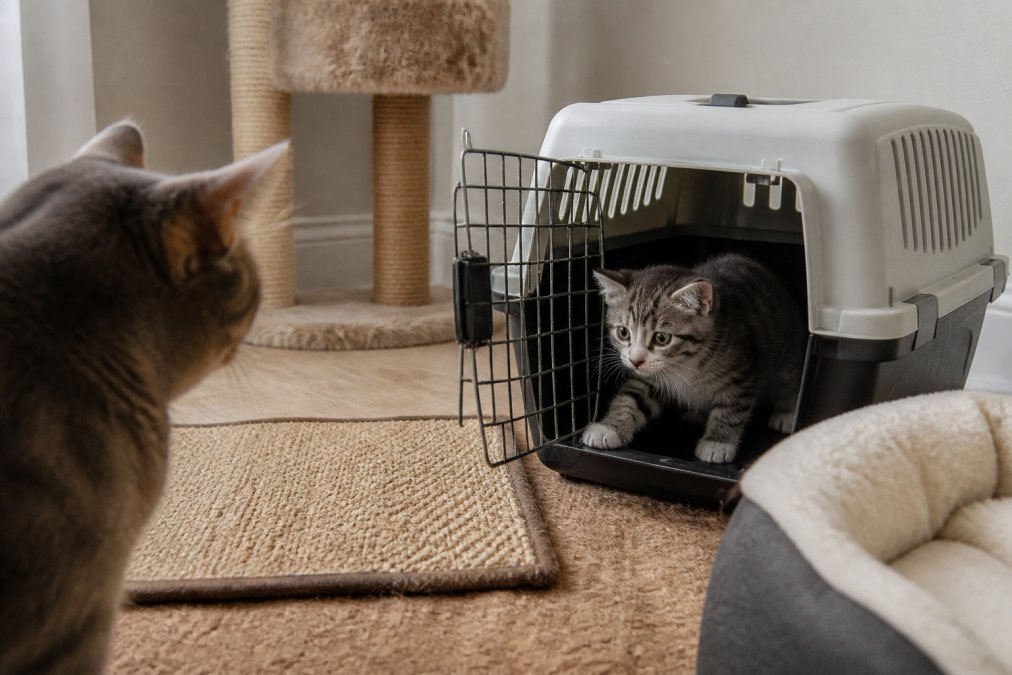
Table of Contents
- Before You Bring the Kitten Home: What to Prepare
- How Long to Keep Cats Separated During the Introduction
- Scent Swapping Techniques for Cats: The First Real Introduction
- Signs of Cat Aggression During Introduction (and What's Just Play)
- Best Supplies for Kitten Introduction: Enrichment That Reduces Tension
- Supervised Visual Introductions and Beyond
- Frequently Asked Questions
Last Updated: September 25, 2026
Before You Bring the Kitten Home: What to Prepare
Learning how to introduce a new kitten to cats starts long before the carrier comes through the door.
Setting Up a Safe Haven for the Kitten
Pick one room for the kitten. A bathroom or spare bedroom works well.
Stock it with:
- A litter box, food, and water
- A cozy bed or blanket
- A scratching post
- A few quiet toys
Managing Your Resident Cat's Routine
Your resident cat notices everything. Keep its feeding, play, and cuddle times exactly the same.
Change nothing. Same bowls, same spots, same schedule.
How Long to Keep Cats Separated During the Introduction
Plan for one to two weeks of separation as a baseline. Some pairs need three or four. The right timeline depends on your cats, not a calendar, and it depends heavily on the age and temperament of your resident cat.
The Four Stages, and What "Ready" Looks Like at Each
Treat the introduction as four gates. You do not advance until both cats pass the gate you are on.
- Closed-door separation (days 1-3). The kitten lives in its safe room. The resident cat has full run of the rest of the home. Success looks like: both cats eating normally, using the litter box normally, and no obsessive door-guarding or door-scratching.
- Scent and site swapping (days 3-7). Trade blankets, then trade rooms for short periods so each cat explores the other's territory while the other is confined. Success looks like: curiosity instead of avoidance, and no hissing when the swapped item is placed near the food bowl.
- Feeding on opposite sides of a closed door (days 5-10). Bowls start several feet back and move closer only when both cats eat without pausing. Success looks like: both cats finishing a meal with the door between them and no growling.
- Visual access through a gate or cracked door (days 7-14+). Short sessions, five minutes or less, building to longer ones. Success looks like: relaxed ears, slow blinks, and the ability to look away from each other.
Watch for These Green Lights
- No hissing at the closed door
- Both cats eat normally
- Your resident cat stops guarding the door
- The kitten explores its room instead of hiding
- Either cat initiates a slow blink toward the other
If you see growling, swatting, or hiding, slow down. That's not failure. It's feedback.
Age Changes the Clock
This is where most guides go generic, and it matters more than any single technique.
- Kitten to senior cat (10+ years). Expect the longest timeline, often three to six weeks. Senior cats are less tolerant of sudden change, may have arthritis or sensory decline that makes a bouncy kitten feel like a threat, and often need their routine protected more aggressively. Keep the kitten's play sessions frequent so it does not pester the senior cat, and give the senior cat elevated resting spots the kitten cannot reach.
- Kitten to young adult cat (1-7 years). Usually the fastest pairing. A playful adult often warms up within one to two weeks and may become a genuine play partner. Watch for over-arousal during play and break sessions before either cat gets overstimulated.
- Kitten to another kitten. Often the easiest of all, but do not skip the process. Kittens still need a safe room and a gradual introduction, and they bond fastest when they are close in age.
Multi-Cat Households Need a Different Plan
If you already have three or more cats, do not introduce the kitten to the group. Introduce the kitten to one cat at a time, starting with the most confident, least reactive cat in the house.
A workable sequence:
- Complete the full four-gate process with Cat A while the other cats stay separated from the kitten.
- Once Cat A and the kitten are calm together, add Cat B to supervised sessions.
- Repeat until every cat has met the kitten individually.
- Only then allow group time, and keep it short at first.
Pro Tip
Keep a simple log, date, stage, and what you observed. Patterns show up fast, and it is easy to forget that last Tuesday's hiss was actually progress compared to the week before.
When to Reset
If two weeks pass and you are still seeing hard hissing, swatting, or a cat refusing to eat, do not push forward. Go back one full stage, hold there for three to five days, and try again. A reset is not starting over, it is giving the slower cat the time it needed.
Scent Swapping Techniques for Cats: The First Real Introduction
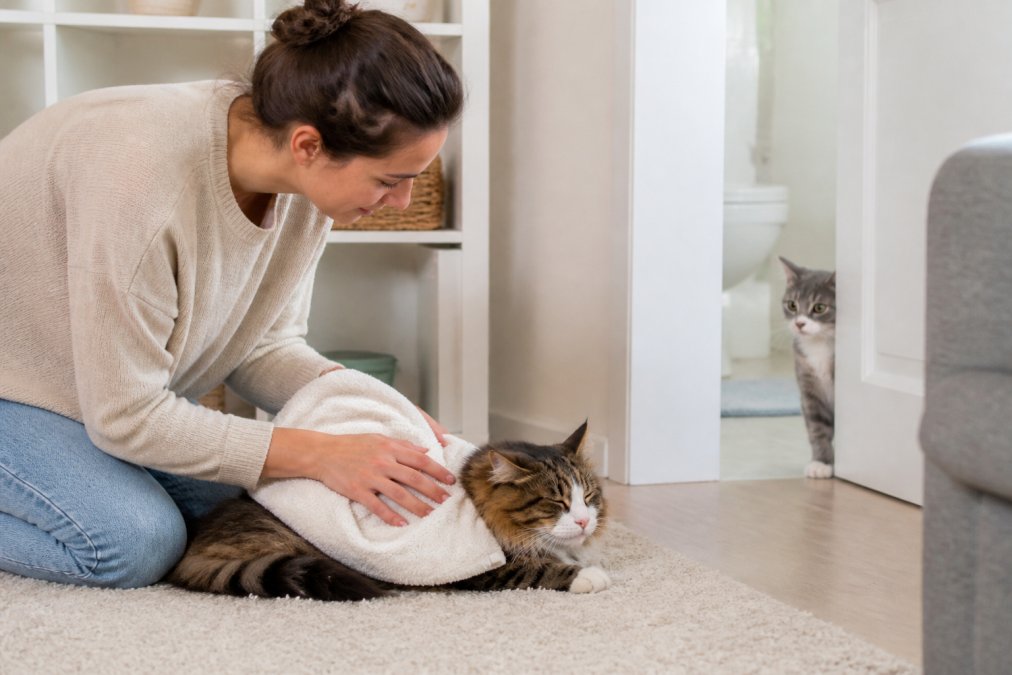
Scent swapping is the practice of trading smells between cats so they learn each other's scent before they ever see each other. For cats, smell is identity.
Scent Swapping with Blankets and Toys
Rub a soft cloth or blanket on your resident cat's cheeks and flanks. Then place it in the kitten's room.
Feeding on Opposite Sides of a Door
Set up two feeding stations, one on each side of a closed door.
Signs of Cat Aggression During Introduction (and What's Just Play)
Not every swipe means war. Play and aggression look different once you know the tells.
True aggression includes:
- Flattened ears and a puffed tail
- Deep growling or hissing
- Stiff, frozen posture
- Real contact that draws blood or fur
Reading Feline Body Language: Ears, Tail, and Posture
Feline body language is the clearest signal you'll get. Learn three things:
- Ears: Forward means curious. Flat back means scared or angry.
- Tail: A slow wave is relaxed. A fast flick or puffed tail means stress.
- Posture: A relaxed cat moves loosely. A tense cat freezes or crouches.
Best Supplies for Kitten Introduction: Enrichment That Reduces Tension
Bored cats fight more. Give both cats outlets for their energy and control over their space, and tension drops fast. The tools below are not just nice-to-haves, each one solves a specific problem that shows up during a kitten introduction.
Environmental Enrichment: The Tools That Actually Change Behavior
Baby gates. A tall, walk-through baby gate is the single most useful piece of equipment for the visual-introduction stage. It lets the cats see and smell each other without contact, and it gives both cats the option to walk away. Look for a gate tall enough that a determined cat cannot clear it, many standard child gates are not.
Interactive Toys That Redirect Energy
A tired cat is a calm cat. Interactive toys let your kitten and resident cat burn off stress safely, on their own.
Pawsibly Everything carries a few standouts:
- The Interactive Cat Toy - Automatic Moving Touch & Run Mouse Toy zips away when tapped, with an ultra-quiet motor that won't startle shy cats.
- The Self Rolling Cat Toy Ball - Automatic Motion Activated LED rolls on its own with a glowing LED ring and obstacle avoidance, so it never gets stuck under the couch.
- The Electric Automatic Infrared Cat Teaser Toys and Electric Intelligent Teasing Cat Charging Toys offer hands-free play for busy pet parents.
Matching the Tool to the Stage
| Stage | Most Useful Tools |
|---|---|
| Closed-door separation | Pheromone diffusers, scratching posts, kitten's safe-haven setup |
| Scent swapping | Soft blankets or cloths, a second litter box |
| Door feeding | Two feeding stations, food puzzles to slow eating |
| Visual introduction | Baby gate, tall cat tree, hiding spots with two exits |
| Supervised time together | Interactive toys, wand toys, treats for positive reinforcement |
Positive Reinforcement: The Glue That Holds It Together
Treats and praise do more work than most owners expect. Every time the cats are near each other and calm, something good should happen, a treat, a soft word, a play session. Over time, the other cat becomes the predictor of good things rather than a source of stress.


Supervised Visual Introductions and Beyond
Once both cats eat calmly near the door, it's time to let them see each other.
The First Face-to-Face Meeting
Start with a cracked door or a baby gate. Let them look, not touch.
Troubleshooting Failed Introductions
Introductions stall for a few common reasons. Here's how to fix each:
| Problem | Likely Cause | Fix |
|---|---|---|
| Hissing at the door | Moved too fast | Go back to scent swapping for 3-5 days |
| Kitten hides constantly | No safe haven | Give kitten a quiet room with a covered bed |
| Resident cat stops eating | Stress | Feed on opposite sides of the door, farther apart |
| Swatting during meetings | No escape route | Add vertical space so either cat can retreat |
Frequently Asked Questions
How long does it usually take for a cat to accept a new kitten?
Most introductions take between one and four weeks, but every cat is different. Some resident cats adjust in a few days, while others need a month or more. The key is to move at your cat's pace, not a calendar. If you see hissing or growling, that's normal early on. Keep sessions short and positive. Rushing the process often backfires and can create long-term tension between the two cats.
What is the 3-3-3 rule for new kittens?
The 3-3-3 rule is a general guideline for how a new kitten settles in: three days to decompress, three weeks to learn your routine, and three months to feel fully at home. During the first three days, keep the kitten in a separate room with food, water, a litter box, and a hiding spot. This gives them time to adjust to new smells and sounds without the added stress of meeting your resident cat.
What not to do when introducing a kitten to a cat?
Never put the kitten and resident cat in the same room and hope for the best. Avoid holding one cat while the other approaches, as this can trigger swatting or biting. Don't punish hissing or growling, since these are normal communication. Skip forced interactions and never leave them unsupervised until you're confident they're comfortable. Also, don't wash all the scent away from the kitten before the introduction; familiar smells help the resident cat adjust.
Should I keep the kitten in a separate room?
Yes, start with a separate room for at least the first few days. This safe haven lets the kitten decompress and gives both cats time to get used to each other's scent through the door. Choose a room with a litter box, food, water, and comfortable bedding. Swap blankets and toys between the rooms to build familiarity. Once both cats seem relaxed, you can begin supervised visual introductions through a cracked door or baby gate.
Bringing a new kitten home is exciting, but the first few weeks set the tone for years of peace. Slow transitions, patience, and the right supplies make all the difference.
Pawsibly Everything is here to help with that. Our interactive toys, cozy beds, and grooming essentials are built to keep every pet comfortable, from a nervous kitten to a settled senior cat. Add to Cart and give your new arrival the welcome it deserves.
