

Cart
0

Table of Contents
- Why Swap Plastic Fish Tank Toys for Safer Options
- Aquarium Safe Materials for DIY Decor
- Natural Aquarium Decoration Ideas That Look Real
- How to Clean Rocks for Fish Tank Use
- Top Picks: Ceramic and Resin Alternatives to Plastic Toys
- Long-Term Durability and Chemical Leaching Concerns
- Conclusion
- Frequently Asked Questions
Last Updated: September 14, 2026
Why Swap Plastic Fish Tank Toys for Safer Options
Cheap plastic ornaments are the default purchase for most new fish keepers, and most of them end up in a landfill within a year (the EPA). Alternatives to plastic fish tank toys solve that problem at the source, because ceramic, resin, and natural materials hold their color and structure without shedding anything into the water column.
The practical case is simple. Plastic decor is molded from petroleum-based compounds, and many budget pieces are finished with paint or dye that was never designed for permanent submersion. Over months of warm water and constant light exposure, that finish breaks down. The result is a dull ornament, a film on the glass, and water chemistry you now have to chase.
Watch Out
Painted plastic ornaments are the most common culprit behind unexplained water cloudiness in small tanks. Once the paint layer degrades, no amount of water changes fixes the source, only removing the ornament does.
The alternatives below, ceramic, resin, and natural stone, sidestep that failure mode entirely. Below, we'll show you exactly which materials are safe, how to build your own decor, and how to clean it without harming your fish.
Aquarium Safe Materials for DIY Decor
Aquarium safe materials for DIY decor are those that stay chemically inert underwater: kiln-fired ceramic, cured aquarium-grade resin, natural stone, and untreated hardwood. Anything that leaches dye, softens, or breaks down in warm water is disqualified before you start building.
The material list is short because the requirements are strict. Your decor sits in a closed system where every surface touches the same water your fish breathe.
- Kiln-fired ceramic and terracotta: inert once fired, heavy enough to stay put, and porous enough to host beneficial bacteria.
- Aquarium-grade polyresin: non-toxic, fade-resistant, and safe in both freshwater and marine setups.
- Natural rock (slate, granite, quartz): stable and inert, but test before adding.
- Driftwood and cured hardwood: safe once fully waterlogged and free of bark.
- Food-grade resin and marine epoxy: acceptable for sealing, provided they cure fully before submersion.
What most guides miss is the difference between "waterproof" and "aquarium safe." A waterproof craft sealer keeps water out, but it can still release compounds into the water. Only products labeled for aquarium or potable-water use belong in a tank.
Non-Toxic Sealants and Adhesives
The safest sealant for aquarium decor is 100% silicone labeled for aquarium use, with no mildewcide or antifungal additive. That last detail matters more than the brand name.
Most hardware-store silicone contains a fungicide to prevent mold in bathrooms (pubmed.ncbi.nlm.nih.gov). In a fish tank, that additive is a slow-release toxin. Read the tube before you buy: if it says "mildew resistant," it does not go near your fish.
For bonding stone and ceramic, cyanoacrylate gel (the thick, gap-filling type) cures fast and is widely used in reef and freshwater builds. For larger structural joins, marine epoxy rated for underwater use works, but it needs a full cure, typically 24 to 48 hours, before the piece touches tank water.
Pro Tip
Cure every sealed or glued piece in a separate bucket of dechlorinated water for several days before it goes in the tank. If the water smells sharp or the piece feels slick, cure it longer. This step catches a bad sealant before it ever reaches your fish.
Natural Aquarium Decoration Ideas That Look Real
Natural aquarium decoration ideas work because they mimic the structures fish already seek out: crevices, overhangs, and shaded caves. Real rock and wood deliver that instantly, without the painted finish that gives plastic away.
The best-looking tanks rarely rely on a single showpiece. They build layers.
- Stacked slate forms flat ledges that bottom-dwellers rest on and fry hide beneath.
- Driftwood branches create the tangled root structure that mimics a riverbed, and they double as a grazing surface for biofilm.
- River stones in mixed sizes anchor the layout and break up the flat line of the substrate.
- Ceramic caves slot into gaps where natural rock would be too heavy or too sharp.
A common mistake is treating decor as a one-time purchase. Natural materials shift, and fish rearrange light pieces. Anchor heavy stone on a stable base and leave the lighter pieces free so you can rescale the layout as the tank matures.
Rocks, Driftwood, and Ceramic Caves
Rock and driftwood give you scale and texture; ceramic gives you control. A ceramic cave is manufactured to a specific size and shape, so you know exactly what shelter you're adding, and it will not alter your pH or hardness parameters.
That predictability is why ceramic works so well alongside natural stone. You get the organic look from the rock and wood, and the guaranteed-safe hideout from the ceramic piece.
How to Clean Rocks for Fish Tank Use
To clean rocks for fish tank use, scrub them under running water with a stiff brush, then boil or soak them to remove organic debris. Skip soap entirely, because residue clings to porous surfaces and leaches back into the tank.
Here is the sequence that works:
- Rinse loose dirt and grit off under warm running water.
- Scrub the surface with a dedicated brush, never one used with soap.
- Boil smaller stones for 10 to 15 minutes, or pour boiling water over larger ones that won't fit in a pot.
- Soak for 24 to 48 hours in a bucket of dechlorinated water.
- Test with a few drops of white vinegar. If the rock fizzes, it contains calcium carbonate and will raise your pH, so leave it out (Hardness of Water).
- Place only after the rock is fully cool and dry.
For store-bought ceramic and resin pieces, skip the boiling step. Warm water, a soft brush, and a rinse are enough. Boiling can crack resin and stress the finish on glazed ceramic.
| Material | Cleaning Method | Frequency | Watch Out For |
|---|---|---|---|
| Natural rock | Scrub, boil, soak | Before first use | Vinegar fizz means it raises pH |
| Driftwood | Rinse, soak until waterlogged | Before first use | Tannins tint water for weeks |
| Ceramic caves | Warm water, soft brush | Monthly | Chips if knocked against glass |
| Resin ornaments | Warm water, soft brush | Monthly | Never boil; finish can crack |
Top Picks: Ceramic and Resin Alternatives to Plastic Toys
The strongest alternatives to plastic fish tank toys are kiln-fired ceramic and aquarium-grade resin, because both are inert, durable, and built to stay submerged. They cost a little more upfront than a bargain-bin plastic castle, and they hold up far longer.
Ceramic Aquarium Shrimp Cave Hide Collection
The Ceramic Aquarium Shrimp Cave Hide Collection is the pick for nano tanks, shrimp keepers, and anyone breeding bottom-dwelling species. At $14.59, it is the most functional piece in this category.

The material is the story here. High-purity, kiln-fired purple clay terracotta is completely inert, so it will not shift your pH, hardness, or any other water parameter. That matters in a shrimp tank, where a small volume of water means even a minor swing can stress the whole colony.
The collection includes several shapes. Each geometry creates a visual barrier that mimics natural rock crevices, which is exactly what vulnerable livestock need during molting and spawning. The unglazed, high-porosity surface also gives nitrifying bacteria a place to anchor, providing passive biological filtration, and it holds live moss or grows biofilm that shrimp fry graze on.
Best for: Nano tanks, shrimp breeders, and aquascapers who want shelter that doubles as a bio-surface.
The drawback: The earthy brown tone is subtle by design. If you want a bright focal point, this is not that piece.
Aquarium Castle Decoration Large Fish Tank Hideout Ornament
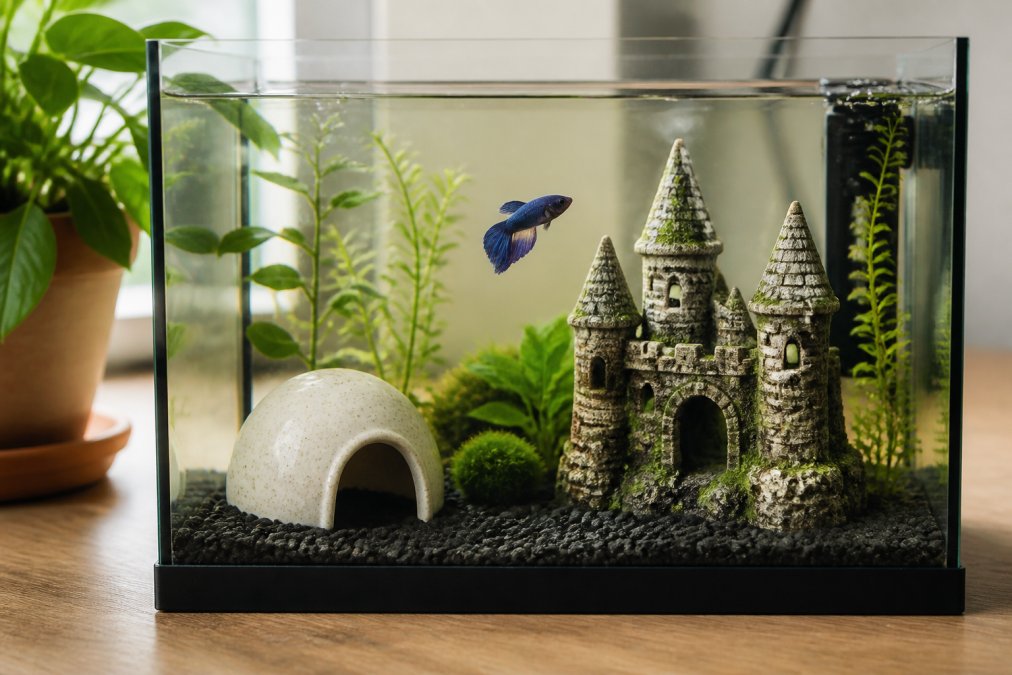
For medium to large tanks that need a centerpiece, the Aquarium Castle Decoration delivers drama and function in one piece. It runs $18.05 and is built from non-toxic, pet-safe polyresin that will not fade, chip, or release toxins in freshwater or marine setups.

The sculpting is detailed: weathered stone brick, ruined battlements, and faux moss climbing the towers. More importantly, the layout is packed with hollow swim-through pathways, open archways, and dark interior caverns. Those openings give territorial fish, shrimp, and nocturnal bottom-dwellers real hiding spots, which reduces stress in a community tank.
The weighted stone-molded base is the detail that separates this from cheaper resin castles. It stays anchored on the substrate even when a cichlid shoves it or a filter current pushes against it. The smooth, hand-finished interior edges also prevent fins from snagging.
Best for: Community tanks with semi-aggressive species that need territory breaks.
The drawback: Its size makes it a poor fit for anything under a 10-gallon setup.
If you want to round out the visual effect, the Aquarium LED Bubble Light at $10.14 combines a submersible LED with an air stone disk, adding ambient lighting and aeration without a separate fixture.

Long-Term Durability and Chemical Leaching Concerns
Chemical leaching is the real argument against cheap plastic decor, and it is a long-term problem, not an immediate one. A plastic ornament rarely fails on day one. It fails over months of heat, light, and constant submersion.
The mechanism is straightforward. Painted and dyed plastics are finished with a surface layer that was never formulated for permanent underwater exposure. Over time, UV from tank lighting and warm water weaken that layer. The finish dulls, then flakes, and the compounds underneath begin to release into the water. You cannot see most of this happening.
Ceramic and quality resin avoid the problem by construction. Kiln-fired ceramic is inert all the way through, so there is no surface layer to wear off. Aquarium-grade polyresin is manufactured to resist fading and to hold its structure in both freshwater and marine conditions. Neither one introduces a finish that can degrade into the water column.
Durability follows the same logic. A ceramic cave that is dropped on a hard floor can chip, but underwater it outlasts plastic by years. Resin is lighter and more forgiving of knocks. Both hold their color far longer than a painted plastic piece, which means you replace them less often, and that is the sustainability angle most guides skip entirely.
A simple maintenance routine keeps any of these pieces in service for years:
- Scrub ceramic and resin monthly with a soft brush in warm water.
- Skip soap, bleach, and hot water on resin.
- Inspect for chips after any tank rescape.
- Replace any piece showing cracks or a peeling surface, regardless of material.
Key Takeaway
The single most important test for any aquarium decor is whether it has a surface finish that can wear off. Inert materials like kiln-fired ceramic have nothing to leach because there is no coating to break down.
Conclusion
Choosing decor that will not cloud your water, stress your fish, or need replacing every year takes a little more thought upfront, and it pays off in a tank that stays stable. Ceramic and aquarium-grade resin give you the look of natural rock with none of the leaching risk, and natural stone and driftwood fill in the texture around them.
Pawsibly Everything carries the pieces that make this easy: the Ceramic Aquarium Shrimp Cave Hide Collection for nano and shrimp setups, the Aquarium Castle Decoration for larger community tanks, and the Aquarium LED Bubble Light to bring the whole aquascape to life. Each one is built from materials that hold up underwater, not just look good in a product photo.
Get started with Pawsibly Everything and build an underwater world your fish can actually live in.
Frequently Asked Questions
What materials are safe to put in a fish tank?
Safe materials for a fish tank include kiln-fired ceramic, aquarium-grade resin (polyresin), natural rocks like slate or granite, driftwood, and borosilicate glass. Avoid untreated metals, painted items, and plastics that can leach chemicals. Always rinse new decor in warm water, and verify that any sealant is aquarium-grade. For a natural look, ceramic caves and resin castles offer durability and non-toxic properties. These alternatives to plastic fish tank toys support a healthier aquatic environment.
How do I know if an aquarium ornament is non-toxic?
Check for labels like 'aquarium-safe,' 'non-toxic,' or 'fish-safe.' Avoid ornaments with peeling paint, strong chemical odors, or sharp edges. Ceramic and resin ornaments from reputable brands are fired or cured to be inert. For DIY items, use aquarium-grade sealants and avoid household glues. If unsure, soak the item in a bucket of water for 24 hours and test the water parameters before adding it to your tank.
Can I use household items as aquarium decor?
Some household items can work, but you must verify they are non-toxic and won't leach chemicals. Safe options include ceramic mugs (lead-free), glass jars, and certain rocks like granite. Avoid anything with paint, metal, or unknown plastics. Always clean thoroughly and rinse well. For a reliable alternative to plastic fish tank toys, choose dedicated aquarium decor made from ceramic or resin, which is designed to be safe and durable in water.
How to properly clean and prepare natural decor for an aquarium?
To clean rocks for a fish tank, scrub them with a new toothbrush under warm water. Never use soap or detergents. For driftwood, boil it for 20 minutes to remove tannins and kill bacteria. Soak rocks in a bucket of water for 24 hours to check for leaching. Ceramic and resin ornaments can be rinsed with warm water and a soft brush. Always avoid chemicals, and let items cool before placing them in the tank.
Are ceramic decorations better than plastic for fish tanks?
Ceramic decorations offer several advantages over plastic. They are kiln-fired, making them chemically inert and less likely to leach toxins. Their porous surface supports beneficial bacteria, and they don't degrade or become brittle over time. Plastic toys can crack, release microplastics, and harbor bacteria in scratches. For a durable, safe alternative to plastic fish tank toys, ceramic caves and hides are an excellent choice for long-term aquarium use.

